
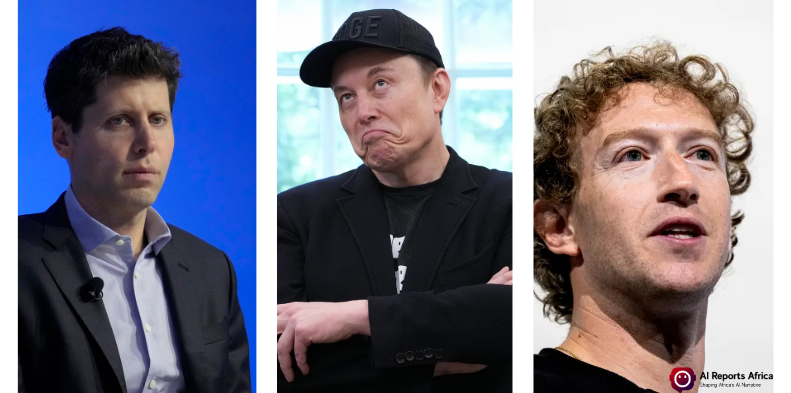
The race to dominate artificial intelligence (AI) is heating up, with tech giants and startups alike vying for supremacy in a field that promises to reshape industries, economies, and societies. From OpenAI’s ChatGPT to Google’s Gemini, Anthropic’s Claude, Meta’s Superintelligence Lab, xAI’s Grok, Perplexity AI, and others, the competition is fierce, marked by rapid innovation, massive investments, and an aggressive talent war. But who’s ahead, who’s poaching talent, and who’s likely to come out on top based on current trends? Let’s dive into the state of the AI war in 2025.
The Contenders and Their Strategies
OpenAI: The Pioneer Under Pressure
OpenAI, the creator of ChatGPT, has long been a frontrunner in the AI race. Its models, including GPT-4.1, o4-mini, and the reasoning-focused o1, have set benchmarks for conversational AI and multimodal capabilities like voice and image generation. In 2025, OpenAI continues to innovate with its “12 Days of Shipmas” updates, integrating ChatGPT into platforms like Apple Intelligence and rolling out advanced voice modes. The company boasts 500 million weekly users and $10 billion in annual revenue, a testament to its commercial success.
However, OpenAI is facing significant challenges. The company has lost key researchers to rivals, particularly Meta, which has poached talent like Shengjia Zhao (a ChatGPT co-creator), Jiahui Yu, Shuchao Bi, Jason Wei, and Hyung Won Chung. These departures, described as a “major loss” by OpenAI insiders, have sparked internal turmoil, with Chief Research Officer Mark Chen likening the poaching to “someone breaking into our home.” OpenAI is countering with competitive compensation packages and has recruited talent from Tesla, xAI, and Meta, but the talent drain is a notable setback.
Google: Catching Up with Gemini and Deep Research
Google, initially caught off-guard by OpenAI’s ChatGPT, has regained momentum with its Gemini family, particularly Gemini 2.5 Pro and Deep Research. Launched in December 2024, Deep Research leverages Google’s unparalleled search infrastructure to deliver comprehensive, multi-step research reports, making it a strong contender for academic and professional use. Gemini 2.0 Flash, twice as fast as its predecessor, supports multimodal tasks like image and audio generation, positioning Google as a leader in agentic AI—systems that act autonomously on users’ behalf.
Google’s strength lies in its ecosystem integration (Docs, Gmail, Google Cloud) and vast data resources, including Reddit content for training. With 450 million monthly active users and a global network of data centers, Google is scaling AI efficiently. However, its reasoning capabilities lag slightly behind OpenAI’s on some benchmarks, and its Deep Research tool, while powerful, is still refining its analytical depth.
Anthropic: The Safety-First Dark Horse
Anthropic, founded by ex-OpenAI researchers, is carving a niche with Claude, particularly Claude 4.0 Sonnet and Opus. Known for its focus on safety and enterprise use cases, Claude excels in conversational naturalness and context retention, making it ideal for complex, multi-turn discussions. Recent updates include web search capabilities and a $200/month enterprise subscription, signaling Anthropic’s pivot toward corporate clients via partnerships with AWS and Google Cloud.
Despite its $61.5 billion valuation, Anthropic struggles with consumer mindshare compared to OpenAI and Google. Its safety-first approach, while admirable, limits its agility in the fast-paced consumer market. Posts on X suggest Anthropic’s compute resources may not match those of its rivals, potentially capping its ability to scale.
Meta: The Aggressive Talent Poacher
Meta has emerged as a wildcard in the AI race, aggressively building its Superintelligence Lab under the leadership of Alexandr Wang and Nat Friedman. By poaching high-profile researchers from OpenAI (e.g., Shengjia Zhao, Jiahui Yu, Shuchao Bi, Jason Wei, Hyung Won Chung) and Google DeepMind, Meta is assembling a formidable team focused on advancing toward artificial general intelligence (AGI). Offers of $100 million signing bonuses and up to $300 million over four years underscore Meta’s financial commitment.
However, Meta’s AI models, like the Maverick AI, lag behind competitors in performance, ranking lower on benchmarks. Critics on X argue Meta is “collecting researchers like Pokémon” without a clear lead in model capabilities. Its focus on talent acquisition may be a long-term play, but it’s not yet translating into consumer-facing dominance.
xAI: Grok’s Real-Time Edge
xAI, backed by Elon Musk, is pushing Grok 4 as a real-time, citation-backed conversational AI integrated with X’s platform. Launched in July 2025, Grok 4 has gained traction for its “raw intellect” and is seeing renewed growth in traffic share. xAI’s recent API release and a $300 million deal to integrate Grok into Telegram signal its ambition to expand beyond X.
While Grok excels in real-time answers and has a loyal following among Musk’s fanbase, it lacks the broad ecosystem of Google or the user base of OpenAI. Its compute resources are also constrained compared to the tech giants, but xAI’s focus on open ecosystems and real-time data gives it a unique edge.
Perplexity AI: The Research Specialist
Perplexity AI has carved out a niche as a research-focused “answer engine,” offering transparent citations and real-time web search. Its Comet browser, launched in July 2025, integrates AI models like Claude 4.0, GPT-4.1, Grok 4, and Gemini 2.5, allowing users to switch between backends. With 22 million active users and backing from telecom giants like Telefónica and SoftBank, Perplexity is a serious contender in AI-driven search.
However, Perplexity faces challenges. Its reliance on third-party models limits its differentiation, and legal disputes over web scraping (e.g., from Forbes and the BBC) have raised ethical concerns. Posts on X and Reddit question its relevance as OpenAI’s SearchGPT and Google’s Deep Research encroach on its territory.
Others: DeepSeek and Emerging Players
DeepSeek, a Chinese startup, is gaining attention for its cost-effective, open-source models like DeepSeek-V2 and R1, optimized for coding and Chinese NLP. Its ability to run on smaller compute footprints makes it attractive for researchers and developers. However, it lacks the consumer presence of its Western counterparts. Other players like Qwen and emerging startups are also in the mix, but their impact remains limited for now.
The Talent War: Who’s Hijacking Whom?
The AI race isn’t just about models—it’s about people. Meta has been the most aggressive in poaching talent, luring away OpenAI’s top researchers like Shengjia Zhao and the Zurich office trio (Lucas Beyer, Alexander Kolesnikov, Xiaohua Zhai) from Google DeepMind. Mark Zuckerberg’s personal outreach and massive financial incentives have made Meta a magnet for talent, though at the cost of internal morale at OpenAI, where leaders are “recalibrating comp” to retain staff.
OpenAI, in turn, has recruited from Tesla, xAI, and Meta, showing it’s not out of the fight. Google and Anthropic, while less aggressive, benefit from stable teams and strong academic ties. Perplexity, despite its growth, struggles to compete for top talent due to its smaller scale, as noted by CEO Aravind Srinivas when a Meta researcher declined an offer citing compute resources.
Who’s Coming Out Big?
Based on current data, no single player is poised to “win” the AI war outright, but trends suggest a multi-tiered landscape:
- OpenAI remains the consumer leader with ChatGPT’s massive user base and versatile capabilities. However, its talent losses and increasing commercialization raise questions about its long-term innovation pace. The anticipated GPT-5 release in August 2025 could solidify its position if it delivers significant advancements.
- Google is a close second, leveraging its search dominance and ecosystem to challenge OpenAI. Gemini 2.5 Pro and Deep Research are strong contenders for research and enterprise use, and Google’s infrastructure gives it unmatched scalability. Its ability to close the reasoning gap will be critical.
- Anthropic is a leader in enterprise and safety-focused AI, but its consumer presence is limited. Claude’s strengths in reasoning and corporate partnerships make it a dark horse for long-term success, especially in regulated industries.
- Meta is playing the long game, building a superintelligence team with top talent. While its models lag, its aggressive hiring and financial muscle could yield breakthroughs by 2026 or beyond.
- xAI is gaining ground with Grok 4’s real-time capabilities and X integration, but its smaller scale limits its reach. It’s a strong niche player for now, with potential to disrupt if compute and partnerships expand.
- Perplexity excels in research but faces pressure from OpenAI’s SearchGPT and Google’s Deep Research. Its reliance on third-party models and legal challenges could hinder its growth unless it innovates further.
The Verdict: A Fragmented Future
The AI war is unlikely to produce a single winner. Instead, we’re seeing specialization: OpenAI and Google dominate consumer and enterprise markets, Anthropic leads in safety and corporate use, Meta is betting on future AGI, xAI thrives in real-time applications, and Perplexity holds strong in research. The talent war, led by Meta, underscores the importance of human capital, but compute resources and data access will ultimately dictate scale.
Posts on X reflect a sentiment of rapid evolution, with GPT-5, Gemini 3, and Grok 4.2 expected to escalate the competition. Chinese players like DeepSeek could disrupt with cost-effective models, potentially outpacing Western rivals on efficiency.
For now, OpenAI and Google are neck-and-neck, with Meta and xAI as wildcards and Anthropic as a steady contender. Perplexity, while innovative, risks being overshadowed unless it differentiates further. The AI war’s outcome hinges on who can balance innovation, talent, and ethics while scaling to meet global demand. As the cycle of breakthroughs continues, 2025 promises to be a pivotal year in this high-stakes race.

I¦ve been exploring for a little bit for any high-quality articles or weblog posts in this kind of house . Exploring in Yahoo I eventually stumbled upon this web site. Studying this info So i am happy to express that I have a very just right uncanny feeling I came upon just what I needed. I most for sure will make certain to don¦t fail to remember this site and provides it a look regularly.
Thank you for your sharing. I am worried that I lack creative ideas. It is your article that makes me full of hope. Thank you. But, I have a question, can you help me?