The continent’s artificial intelligence sector is poised for explosive growth, with projections showing the market could surpass $50 billion by 2035
Africa stands at the threshold of a technological renaissance. While the global conversation around artificial intelligence often centers on Silicon Valley, Beijing, or London, a quiet revolution is brewing across the African continent—one that could reshape the economic landscape and position Africa as a major player in the global AI economy.
According to industry forecasts, Africa’s AI market could exceed $50 billion by 2035, representing not just impressive growth numbers, but a fundamental shift in how the continent approaches innovation, economic development, and its place in the Fourth Industrial Revolution.
The Current Landscape
Today, Africa’s AI ecosystem is nascent but rapidly evolving. From Lagos to Nairobi, Cape Town to Cairo, tech hubs are sprouting up, incubators are nurturing startups, and governments are beginning to recognize AI as a strategic priority. The continent’s young, tech-savvy population—with a median age of just 19 years—represents both a vast market and an untapped reservoir of talent.
Countries like Kenya, Nigeria, South Africa, Egypt, and Rwanda are leading the charge, establishing themselves as regional AI powerhouses. These nations are investing in digital infrastructure, creating favorable regulatory environments, and fostering partnerships between government, academia, and the private sector.
Driving Forces Behind the Growth
Several factors are converging to fuel Africa’s AI boom:
Mobile-First Innovation: With mobile phone penetration rates soaring across the continent, Africa has leapfrogged traditional computing infrastructure. This mobile-first approach creates unique opportunities for AI applications in mobile banking, agriculture, healthcare, and education.
Solving Local Problems: African AI innovators aren’t simply replicating Western solutions—they’re developing AI technologies tailored to African challenges. From crop disease detection helping smallholder farmers to AI-powered diagnostic tools addressing healthcare shortages in rural areas, these solutions have real-world impact.
Growing Investment: Venture capital is flowing into African AI startups at unprecedented rates. International tech giants like Google, Microsoft, and IBM are establishing AI research centers on the continent, while local investors are becoming increasingly sophisticated in identifying promising opportunities.
Government Support: Forward-thinking governments are developing national AI strategies, investing in STEM education, and creating regulatory frameworks that encourage innovation while protecting citizens’ rights.
Key Sectors Poised for Transformation
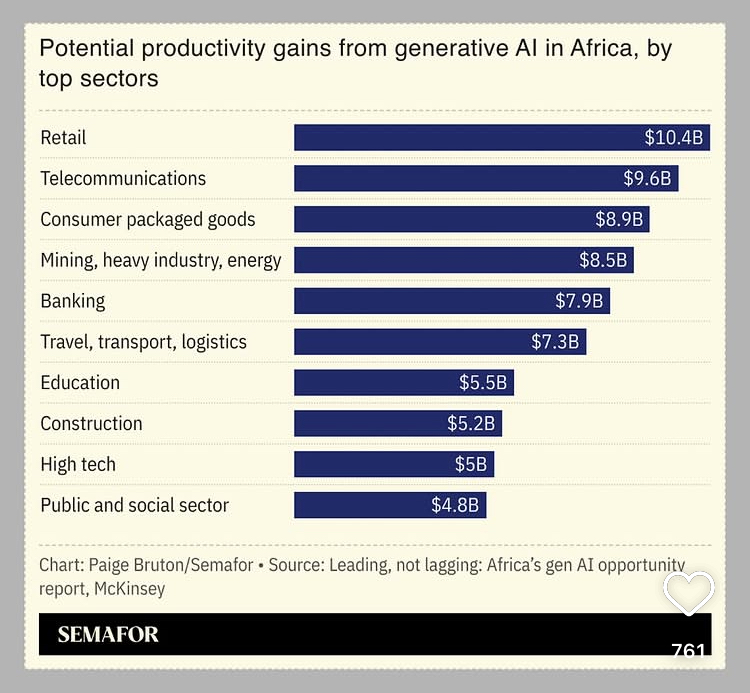
The projected $50 billion market will span multiple sectors:
Financial Services: AI-powered fintech solutions are revolutionizing banking access, credit scoring, and fraud detection across a continent where millions remain unbanked.
Agriculture: With 60% of Africa’s population engaged in agriculture, AI applications in precision farming, yield prediction, and supply chain optimization could dramatically improve food security and farmer incomes.
Healthcare: AI diagnostic tools, telemedicine platforms, and predictive analytics are addressing critical healthcare challenges in regions with severe doctor shortages.
Education: Adaptive learning platforms and AI tutors are democratizing access to quality education, particularly in underserved communities.
Challenges on the Horizon
The path to a $50 billion AI industry isn’t without obstacles. Infrastructure gaps, particularly in reliable internet connectivity and electricity, remain significant barriers. The continent faces a critical skills shortage in AI and data science, though efforts to expand STEM education are underway.
Data privacy concerns, ethical considerations around AI deployment, and the need for inclusive development that doesn’t exacerbate existing inequalities must be addressed. There’s also the challenge of brain drain, as talented African AI researchers are often lured abroad by higher salaries and better resources.
A Continental Awakening
Despite these challenges, optimism abounds. The African Union’s Digital Transformation Strategy and various national AI policies signal recognition at the highest levels that AI represents a historic opportunity for leapfrog development.
Initiatives like the African Observatory on Responsible AI and partnerships with global AI research institutions are helping build local capacity while ensuring African voices shape the global AI conversation.
Looking Ahead
If Africa’s AI industry does reach $50 billion by 2035, it will represent more than economic growth—it will signal a fundamental shift in the global technology landscape. African innovators won’t just be consumers of AI technology developed elsewhere; they’ll be creators, shaping AI applications that reflect African needs, values, and perspectives.
The next decade will be crucial. With sustained investment in education, infrastructure, and innovation ecosystems, combined with policies that foster entrepreneurship while protecting citizens, Africa’s AI revolution could exceed even the most optimistic projections.
As the world watches, Africa isn’t asking for a seat at the AI table—it’s building its own table, and the feast is just beginning.
The views expressed in this article are based on current market projections and industry analysis. Actual market performance may vary based on numerous economic, technological, and geopolitical factors.