How African scientists and tech innovators are harnessing artificial intelligence to build resilient communities and combat climate change
In the heart of Stellenbosch, South Africa, a team of scientists is using cutting-edge artificial intelligence to predict the next dengue outbreak before it happens. In Nairobi, climate tech innovators are gathering to pitch AI-powered solutions for agriculture and water management. Across the continent, from Cape Town to Accra, a quiet revolution is underway—one where artificial intelligence meets Africa’s most pressing challenge: climate change.
The Perfect Storm: Climate Change and Innovation
Africa faces a paradox that defines our time. The continent contributes less than 10 percent of global greenhouse gas emissions, yet it is disproportionately vulnerable to climate change’s devastating effects, from prolonged droughts to catastrophic flooding. But where others see only crisis, African innovators see opportunity.
At the forefront of this movement is the Centre for Epidemic Response and Innovation (CERI) at Stellenbosch University. Under the leadership of Professor Tulio de Oliveira—the scientist who helped identify the Omicron variant—CERI has expanded beyond pandemic response to tackle what he calls “climate-amplified diseases and epidemics” through their CLIMADE initiative.
Using advanced AI techniques, CERI researchers are creating prediction models to understand how climate change impacts the spread of diseases like dengue fever, which thrives as temperatures rise and rainfall patterns shift. The work represents a fundamental shift: AI isn’t just responding to crises—it’s anticipating them.
From Labs to Fields: AI in Action
The practical applications of AI for climate action in Africa span multiple sectors, each addressing critical vulnerabilities:
Precision Agriculture: In sub-Saharan Africa, AI has been used to optimize irrigation and farming practices, improving crop yields in regions affected by unpredictable climate conditions. Machine learning models analyze weather patterns and soil data to provide real-time guidance to farmers, helping them make decisions that could mean the difference between harvest and famine.
Flood Forecasting: Google’s Flood Hub platform now provides riverine flood forecasts in 23 African countries. The platform’s AI model can predict the behavior of rivers that have never been monitored before, which is critical in many parts of Africa where historical data is scarce.
Reforestation Tracking: In Kenya, IBM’s AI models are using NASA satellite data to track and visualize reforestation efforts in real-time, helping the government work toward its ambitious goal of 30 percent tree cover by 2050—triple the previous target.
The Human Element: Training the Next Generation
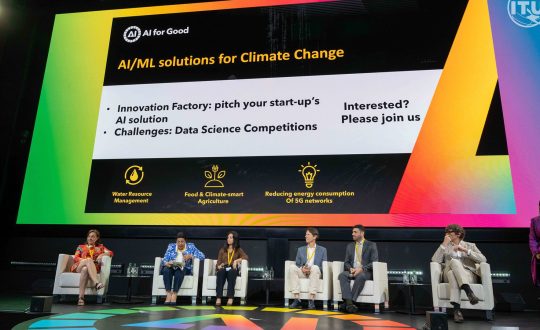
Perhaps the most transformative aspect of Africa’s AI revolution is its focus on building local capacity. At the Africa Tech Festival in Cape Town—which drew over 15,000 delegates in November 2024—AI emerged as a central theme across sessions on governance, enterprise innovation, and climate solutions.
The African Institute for Mathematical Sciences (AIMS), in partnership with Google DeepMind, has launched a pan-African master’s program in AI for Science. The first cohort of 16 graduates included students from Benin, Chad, and Cameroon who worked directly with CERI on using AI to track pathogens and predict climate-driven disease migration.
Olivier Mahumawon Adjagba from Benin, one of the program’s pioneers, exemplifies this new generation of African AI scientists. His work focuses on using AI to understand dengue fever spread across African countries, creating prediction models that inform public health strategies.
Building Networks for Resilience
The transformation isn’t happening in isolation. Multiple initiatives are creating an ecosystem of support:
The AI for Climate Action Innovation Research Network, funded through the Artificial Intelligence for Development Africa (AI4D Africa) partnership, is supporting 10 climate-change innovation research projects and training 10 master’s students focused on the intersection of machine learning and climate change.
The Africa Research and Impact Network (ARIN) is launching research fellowships to nurture scholars working at the intersection of AI and climate resilience, with a particular focus on women’s participation—a critical gap in Africa’s AI workforce.
Tech festivals and summits across the continent have become crucial venues for this work. The AfricArena Nairobi Climate Tech Summit, the African Startups AI Fest, and The AI Summit Cape Town are creating spaces where innovators, investors, and policymakers can connect, collaborate, and scale solutions.
The Governance Challenge
As excitement builds around AI’s potential, African leaders are also grappling with critical questions of governance and equity. At events like the Africa Tech Festival, policymakers are engaging with issues of data sovereignty, algorithmic bias, and ensuring that AI benefits reach marginalized communities.
The success of AI applications in climate action depends on high-quality, comprehensive data, yet access to reliable climate information and the capacity to disseminate it remain significant obstacles for many African nations.
Infrastructure gaps present another challenge. The lack of access to energy and digital infrastructure, such as reliable electric grids, internet, data storage and computing power, severely limits the use of AI for climate action in remote and underserved areas.
A Vision for 2030
Despite these challenges, the momentum is undeniable. CERI’s vision extends beyond individual projects to systemic transformation. The team is using AI and machine learning to tackle pressing research questions, from disease distribution and virus classification to phylogenetics and predicting climate-driven migrations.
The broader AI4D Africa initiative aims to support responsible AI development that advances both climate resilience and economic opportunity. The network will support development and scaling of responsible AI innovations for climate action in sub-Saharan Africa, capacity building of African innovators and researchers, and the increased contribution of African research to international AI policy and practice.
The Road Ahead
As world leaders continue to negotiate climate agreements and commitments, Africa is charting its own path forward—one that leverages the continent’s youthful, tech-savvy population and growing innovation ecosystem.
The work happening at CERI, at tech festivals across the continent, and in countless labs and startups represents more than just technological innovation. It’s a reimagining of what climate action can look like when it’s designed by and for the communities most affected by climate change.
Professor de Oliveira’s words at COP28 resonate with urgency: responsible policymakers must acknowledge the reality of climate-amplified diseases and take swift action to mitigate the impending public health crisis. But his team’s work also offers hope—a demonstration that Africa isn’t just adapting to climate change; it’s pioneering solutions that could benefit the entire world.
As the effects of climate change intensify, the AI-powered tools, trained minds, and collaborative networks emerging across Africa may prove to be among our most valuable resources in building a more resilient future. The question isn’t whether Africa can contribute to solving the climate crisis—it’s whether the rest of the world is ready to follow its lead.
This article draws on research and presentations from the Centre for Epidemic Response and Innovation (CERI), Africa Tech Festival 2024, the AI4D Africa initiative, and interviews with participants in Africa’s growing climate tech ecosystem.