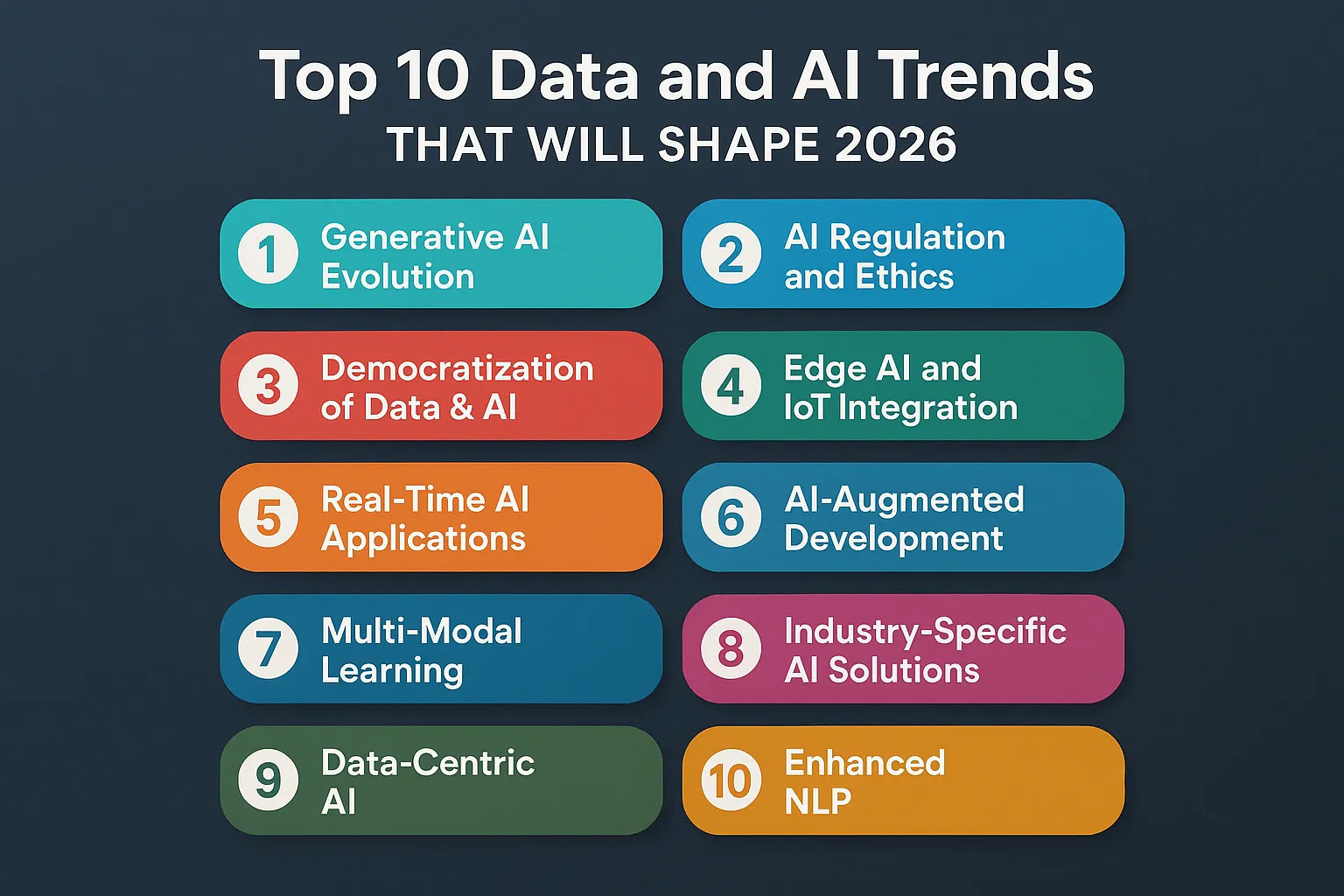
As global adoption of artificial intelligence accelerates, the year 2026 is positioned to be a transformative point for data-driven innovation. Emerging trends—from regulatory reforms to advanced multi-modal models—are defining how governments, enterprises, and consumers will interact with AI systems. Below is a breakdown of the top 10 data and AI trends that will shape 2026, based on current technological trajectories and industry readiness.
1. Generative AI Evolution
Generative AI continues to push boundaries, moving beyond text and image models to highly autonomous multi-agent systems. These models will not only generate content but also execute tasks, build applications, and collaborate with humans in real time. Expect more efficient architectures, reduced hallucinations, and enterprise-grade safety features.
2. AI Regulation and Ethics
As AI becomes deeply embedded in critical sectors, global and regional regulatory bodies—especially in Africa, the EU, and Asia—will enforce stricter AI governance frameworks. Ethical AI development, transparency standards, data-protection compliance, and risk-assessment protocols will become mandatory for organizations deploying AI at scale.
3. Democratization of Data & AI
Low-code and no-code AI tools are empowering non-technical teams to build intelligent solutions. SMEs, startups, journalists, and creators will increasingly access affordable AI systems previously limited to large enterprises. This shift will drive innovation across Africa’s informal sector, education, finance, and media ecosystems.
4. Edge AI and IoT Integration
AI will move closer to devices—phones, sensors, drones, and industrial machines—enabling instant decision-making without relying on cloud connectivity. Edge AI will be crucial for smart cities, agriculture automation, disaster response, and real-time health monitoring across remote or bandwidth-limited regions.
5. Real-Time AI Applications
From fraud detection to live traffic analytics, real-time AI will power critical operations requiring immediate insights. As infrastructure improves, industries such as fintech, cybersecurity, logistics, and public safety will depend on instantaneous data processing for efficiency and risk management.
6. AI-Augmented Development
Developers will increasingly collaborate with AI copilots capable of writing entire modules, debugging code, generating system architectures, and accelerating software lifecycles. This will reduce development time drastically and enable startups in Africa to build world-class products with fewer resources.
7. Multi-Modal Learning
Models that can interpret text, images, speech, video, and sensor data simultaneously will dominate the AI landscape. Multi-modal AI will power immersive learning tools, accessible interfaces for persons with disabilities, advanced translation systems, and next-generation customer experience platforms.
8. Industry-Specific AI Solutions
Hyper-specialized AI models will emerge across sectors like healthcare, energy, education, fintech, manufacturing, and agriculture. These solutions will outperform general-purpose models because they are trained on domain-rich datasets and optimized for specialized tasks such as medical diagnostics, crop disease detection, and financial risk scoring.
9. Data-Centric AI
The industry is shifting from model-centric innovation to data-centric development. High-quality, labeled, compliant, and well-structured data will determine model accuracy and reliability. Companies will invest heavily in data governance, annotation, integration, and quality pipelines to gain competitive advantage.
10. Enhanced Natural Language Processing (NLP)
NLP systems are becoming more context-aware, multilingual, and capable of understanding complex human intent. In Africa, enhanced NLP will support voice-enabled services, local language preservation, AI-powered journalism, government service automation, and more inclusive digital ecosystems.
Conclusion
The AI and data innovations forecast for 2026 will redefine global digital transformation. For Africa, these trends represent massive opportunities—from improving governance with ethical AI to enabling startups with democratized tools. Organizations that embrace these trends early will outperform competitors and shape the next era of technological leadership.