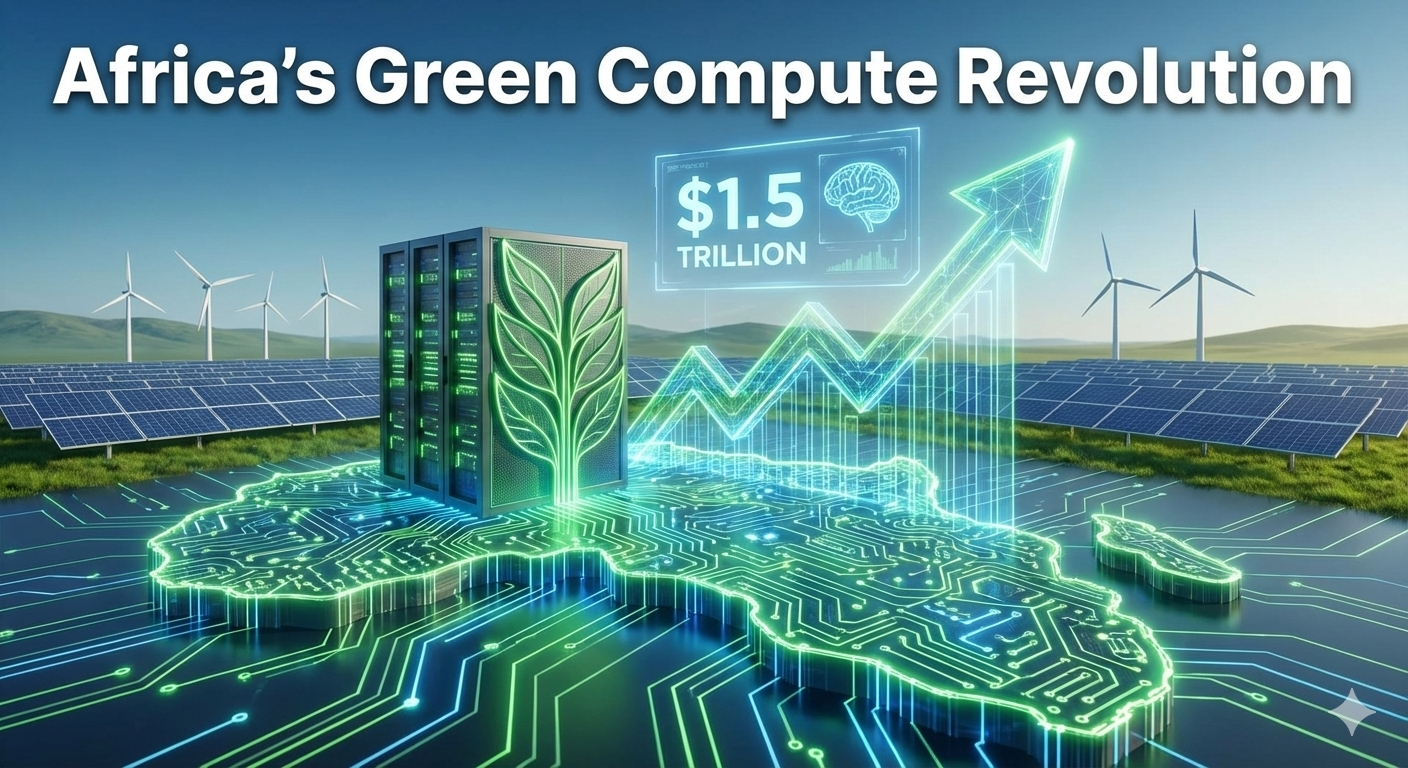
In a continent brimming with untapped potential, a new opinion piece is sounding the alarm—and the opportunity—on Africa’s role in the global AI boom. Published by the World Economic Forum, the article argues that strategic investments in “green” computing infrastructure could unleash up to $1.5 trillion in economic value by 2030, transforming Africa from a bystander to a powerhouse in sustainable technology.
Titled “Investment in ‘Green’ Computing Can Unlock $1.5T in Africa,” the piece, authored by AI experts Alexander Tsado and Robin Miller, highlights what they call Africa’s “AI compute paradox.” Despite surging demand for high-performance computing—essential for training AI models—the continent’s infrastructure lags far behind. Africa represents 18% of the world’s population but less than 1% of global data center capacity, leaving innovators without the tools to compete. “Africa’s compute gap is less about new data centres and more about aligning GPU economics, power costs and demand orchestration,” the authors write, emphasizing that the challenge is systemic, not just structural.
At the heart of this vision is “green” compute: energy-efficient, renewable-powered data centers designed for AI workloads. The authors point to Nairobi’s IXAfrica campus as a prime example. Operational since earlier this year, IXAfrica partnered with Kenyan telecom giant Safaricom in June 2025 to deliver the region’s first AI-ready infrastructure, complete with high-density GPU clusters and sustainable cooling systems. This collaboration aligns with Safaricom’s broader ambitions; in May, the company announced a $500 million investment over three years to build AI infrastructure across East Africa, aiming to bolster everything from cloud services to edge computing.
The economic stakes are staggering. The opinion piece projects that resolving the compute paradox could generate $1.2 trillion to $1.5 trillion in value by addressing market failures like capital mispricing, skills shortages, and coordination gaps. AI alone is expected to add another $1.5 trillion to Africa’s economy by 2030, but only if barriers are dismantled. Currently, just 5% of African AI innovators have reliable access to advanced compute, and the continent faces an unmet demand of 7 million GPU hours for model training over the next three years.
Experts featured in the piece advocate for a multifaceted approach. Philanthropic capital should absorb early risks, while governments act as “anchor tenants” to drive demand and protect data sovereignty. The newly formed Africa Green Compute Coalition (AGCC) is positioned as a key orchestrator, linking policy, finance, energy, and technical expertise. “Africa’s compute challenge is a systems problem requiring collective intervention,” Tsado and Miller stress, calling for subsidies on GPU-as-a-Service models to make computing accessible to startups and researchers.
This isn’t just theoretical. Real-world initiatives are already gaining traction. In Kenya, Microsoft and Abu Dhabi-based G42 have committed to geothermal-powered facilities near Olkaria, leveraging the country’s abundant renewable energy. Senegal’s Diamniadio National Datacenter, operational since 2021, serves as a model for public-private partnerships, while Cassava Technologies’ deal with NVIDIA to deploy 12,000 GPUs underscores the influx of hardware investments. Startups like Udutech are pioneering affordable GPU access, and Amini.ai is developing data infrastructure tailored to African needs, from agriculture to climate resilience.
Broader trends support this optimism. A recent LinkedIn analysis forecasts Africa’s data center construction spend nearly tripling by 2030, with demand growing 3.5 to 5.5 times. At the G20 Summit in Johannesburg, the UAE pledged $1 billion for AI development in Africa, targeting infrastructure gaps. Microsoft is pouring ZAR 5.4 billion (about $297 million) into South Africa’s cloud and AI ecosystem.
Yet challenges remain. High energy costs, regulatory hurdles, and talent migration could stymie progress. The authors warn that without intervention, Africa risks being locked out of the AI economy, perpetuating dependency on foreign tech giants.
As Africa stands at this crossroads, the message is clear: Green compute isn’t just an environmental imperative—it’s an economic lifeline. With coordinated action, the continent could not only meet its AI demands but lead in sustainable innovation, creating jobs, fostering sovereignty, and driving inclusive growth for generations to come.