
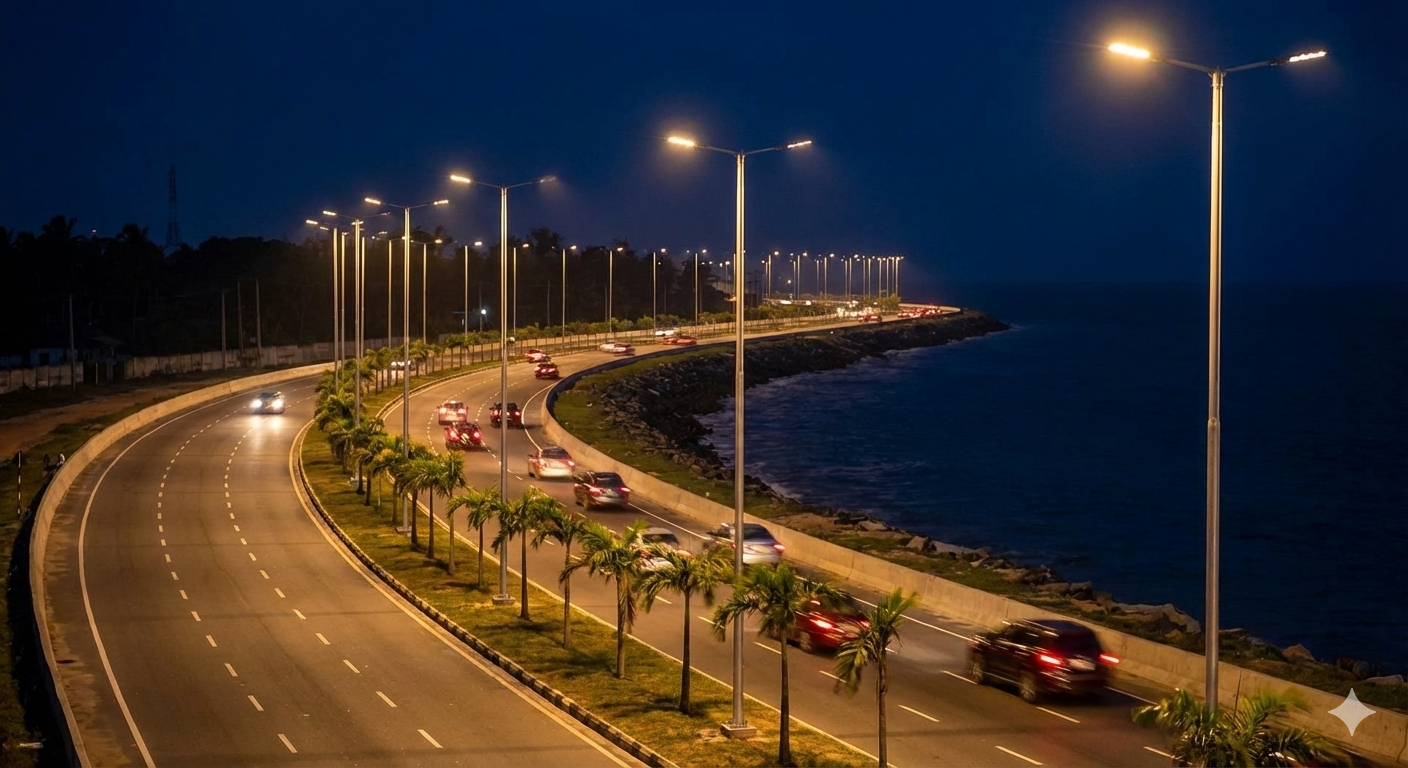
British and Nigerian firms propose transforming infrastructure into revenue-generating AI network
LAGOS — After decades of false starts and mounting controversies, Nigeria’s ambitious Lagos-Calabar Coastal Highway may have found an unlikely savior: thousands of artificial intelligence-powered solar streetlights that double as data centers.
British greentech firm Conflow Power Group and Nigerian infrastructure company Mora Energy have proposed deploying 28,000 “iLamps” along the 700-kilometer highway, a plan currently under discussion with the Nigerian government that could fundamentally reshape how the troubled megaproject gets financed.
The proposal promises to generate up to $1.26 billion annually through a novel combination of energy savings and AI computing revenue—potentially providing a much-needed financial lifeline for a project that has struggled to secure adequate funding since it was first conceived in the 1970s.
A Half-Century Wait
The Lagos-Calabar Coastal Highway has become something of a white elephant in Nigerian infrastructure planning. Designed to connect nine coastal states from the commercial capital Lagos to Calabar in Cross River State, the project has been repeatedly announced, delayed, and rebooted across multiple administrations.
When President Bola Tinubu’s government revived construction in March 2024, the estimated cost had ballooned to between $11 billion and $12.5 billion. Yet as of mid-2024, only $747 million had been secured—less than six percent of the total needed.
The first phase alone, covering just 47.47 kilometers in Lagos State, required 1.06 trillion naira (approximately $670 million) in public funds. The project has also sparked intense controversy over its procurement process, environmental impact on wetlands and mangroves, and the forced demolition of coastal properties.
Turning Lights into Computing Power
Enter the iLamp: a solar-powered streetlight equipped with Nvidia AI processors that can process data for artificial intelligence companies like OpenAI while simultaneously providing LED lighting, surveillance cameras, vehicle recognition, emergency response systems, and public Wi-Fi—all without requiring connection to Nigeria’s often-unreliable electricity grid.
Through a partnership with British firm AI Factories Limited, each iLamp unit becomes a node in a distributed AI computing network. The business model is straightforward: AI companies pay for the processing power, generating up to $4,500 annually per unit.
“The financial mathematics are compelling,” said Zainu Goba, CEO of iLamp Africa. “iLamp doesn’t just provide lighting and security, it creates a new revenue stream that could contribute more than a billion dollars towards project costs annually.”
Stanley Chuka-Umeora, founder of Mora Energy, emphasized how the technology addresses multiple challenges simultaneously. “For 50 years, Nigeria has struggled with this project because we were applying 20th-century solutions to 21st-century problems,” he said. “Government officials were particularly impressed that iLamp solves multiple problems simultaneously. It’s not just about financing, it’s about security, communications infrastructure, and bringing cutting-edge technology to Nigerian communities.”
Distributed Computing Meets Infrastructure
The deployment would establish one of Africa’s largest distributed AI computing networks, enabling AI services to be processed locally rather than overseas. This could position Nigeria as a regional hub for AI infrastructure while supporting the country’s growing technology sector.
The concept taps into a global trend toward edge computing—distributing data processing closer to where it’s needed rather than concentrating it in massive data centers. For AI companies, distributed networks offer redundancy and reduced latency. For host countries like Nigeria, they offer revenue opportunities and technological advancement.
The iLamp proposal would see revenue generation begin as soon as highway sections are completed, reducing dependence on traditional tolling and public funding. Conflow Power Group’s licensing model allows for rapid deployment through partnerships while reducing local energy requirements and the cooling demands typically associated with data centers.
Skepticism and Scrutiny
The proposal emerges against a backdrop of deep public skepticism about the highway project. Critics have questioned the lack of competitive bidding in awarding the main construction contract to Hitech Construction Company Limited, owned by Gilbert and Ronald Chagoury, businessmen with longstanding ties to President Tinubu.
Former Vice President Atiku Abubakar has been particularly vocal, challenging the government to disclose the project’s full cost and questioning why initial assurances that the contractor would self-finance the project evaporated, replaced by massive public expenditure.
Environmental concerns also loom large. The highway traverses sensitive wetlands and mangroves, including habitats for endangered Nigeria-Cameroon chimpanzees and critically endangered Niger Delta red colobus. Environmental impact assessments for much of the route have been delayed or incomplete, according to reports.
The per-kilometer cost has sparked fierce debate. Official figures put it at 4 billion naira per kilometer, but critics allege the real figure is double that—far exceeding international benchmarks and even surpassing costs for similar projects in developed economies.
A Technological Gamble
While the iLamp proposal is innovative, questions remain about its practicality and long-term viability. The technology requires stable internet connectivity to transmit data to AI companies—a potential challenge in some rural areas along the proposed route. Maintenance of sophisticated electronic equipment in tropical coastal conditions also presents logistical hurdles.
Security concerns around surveillance capabilities and data handling would need to be addressed, particularly in a country where trust in government technology initiatives has been eroded by past experiences.
The proposal also doesn’t solve the highway’s fundamental governance problems: opaque procurement processes, incomplete environmental assessments, and inadequate community consultation on land acquisitions and displacement.
A New Model for African Infrastructure?
If successful, the iLamp deployment could represent a new paradigm for financing large-scale infrastructure in developing countries—one that leverages emerging technologies to create revenue streams independent of traditional tolling or public funding.
The model is particularly appealing for nations like Nigeria that face chronic infrastructure deficits but struggle with limited public resources and high borrowing costs. By bundling conventional infrastructure with cutting-edge technology, the approach could attract private investment while delivering multiple benefits beyond transportation.
However, the initiative faces a critical test: whether Nigeria’s government can execute a technology-forward infrastructure project with the transparency, environmental responsibility, and inclusive planning that has been absent from the highway project thus far.
As of December 2025, discussions between the iLamp Africa team, Mora Energy, and the Nigerian government continue. The deployment would require formal integration into the highway project and likely additional regulatory approvals.
For now, Nigeria’s coastal highway remains a symbol of both the country’s infrastructure ambitions and its implementation challenges—with AI-powered streetlights offering a glimpse of how innovation might succeed where traditional approaches have repeatedly failed.
The Lagos-Calabar Coastal Highway is expected to take eight years to complete, with 30 kilometers of the initial Lagos section finished as of mid-2025. The government has indicated plans to review the design to reduce costs and scale down from ten lanes to six.