In a bold move to assert technological sovereignty and foster digital inclusion, Nigeria is intensifying efforts to create “national digital public goods” open, shared resources that any developer, startup, or institution can use to build locally relevant AI solutions. At the forefront of this ambition is N-ATLAS, the country’s pioneering open-source multilingual large language model (LLM), which exemplifies how government-led initiatives are bridging the gap between global AI dominance and Africa’s linguistic realities.
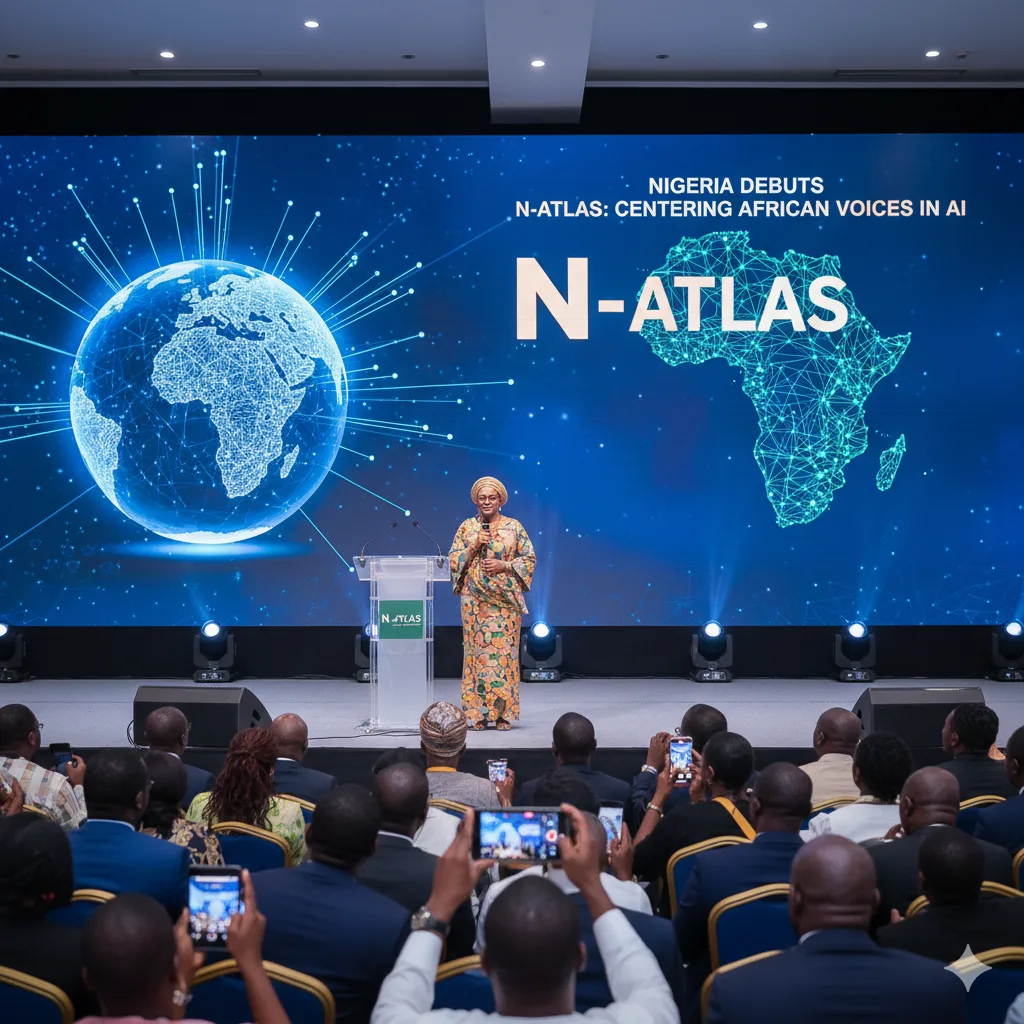
Launched in September 2025 on the sidelines of the 80th United Nations General Assembly (UNGA80) in New York, N-ATLAS short for Nigerian Atlas for Languages & AI at Scale represents a landmark collaboration between the Federal Ministry of Communications, Innovation and Digital Economy, the National Centre for Artificial Intelligence and Robotics (NCAIR), and Lagos-based frontier tech company Awarri, founded by robotics entrepreneur Silas Adekunle.
The model, built on Meta’s Llama-3 8B architecture and fine-tuned for Nigerian contexts, supports Yoruba, Hausa, Igbo, and Nigerian-accented English. It includes multimodal capabilities, such as automatic speech recognition (ASR) for transcription and voice applications, making it a versatile foundation for chatbots, educational tools, healthcare advisories, and customer service systems in local languages.
Minister Dr. ‘Bosun Tijani described N-ATLAS as “more than a language model; it is a national commitment to unity, inclusion, and global contribution.” By open-sourcing it on platforms like Hugging Face, Nigeria is positioning the tool as a true digital public good one that empowers the continent while reducing reliance on foreign LLMs that often fail to handle African languages accurately.
This initiative stems from Nigeria’s broader National Artificial Intelligence Strategy (NAIS), co-created with over 120 experts and aligned with President Bola Ahmed Tinubu’s Renewed Hope Agenda.
The strategy emphasizes five pillars:
responsibility, ethics, inclusivity, sustainability, and collaboration. Key goals include achieving 95% digital literacy by 2030, upskilling millions through programs like the 3 Million Technical Talent (3MTT) initiative, and developing sovereign infrastructure to support local AI innovation.
N-ATLAS addresses a critical pain point in Africa’s AI ecosystem: linguistic exclusion. With over 500 languages spoken in Nigeria alone and more than 2,000 across the continent- global models from companies like OpenAI or Google frequently mispronounce names, misinterpret slang, or outright ignore indigenous tongues. By digitizing and preserving these voices,
N-ATLAS enables practical applications: rural farmers receiving agri-advice in Hausa, students accessing lessons in Igbo, or visually impaired users hearing content in authentic Yoruba accents.
Experts hail it as strategic infrastructure. Dr. Olubunmi Ajala, NCAIR’s National Director, calls N-ATLAS “a foundation for Nigeria’s AI future,” with potential to transform education, healthcare, commerce, and governance. Awarri’s Silas Adekunle emphasizes public-private synergy: “This collaboration ensures Nigeria’s languages are amplified in the age of AI, not sidelined.”
The open-source approach invites ecosystem-wide contributions. Developers can fine-tune N-ATLAS for sector-specific needs, while researchers collaborate on expanding to more languages. This mirrors global digital public goods movements, where shared resources accelerate innovation without proprietary lock-in.
Yet challenges remain. Nigeria’s over 300 AI startups still grapple with compute shortages, unreliable power, and funding skewed toward applications rather than foundational models. Building on N-ATLAS requires sustained investment in data centers, talent pipelines, and ethical governance to prevent biases in local datasets.
As Africa races to contribute to and not just consume global AI, Nigeria’s efforts signal a shift. From grassroots tools like YarnGPT (a private-sector TTS innovator capturing Nigerian accents) to government-backed behemoths like N-ATLAS, the country is weaving a fabric of national digital public goods. These resources not only preserve cultural heritage but also unlock economic potential, potentially adding billions to GDP through inclusive tech.
In Tijani’s words: “N-ATLAS shows Africa is not waiting to be included, we are shaping the future.” As updates roll out and community contributions grow, this initiative could inspire similar efforts across the continent, proving that digital public goods built on local realities can compete on the world stage.
For developers interested in contributing, visit the N-ATLAS model on Hugging Face or the official NCAIR site. Nigeria’s AI journey is just beginning, and it’s one rooted in its own diverse voices.