
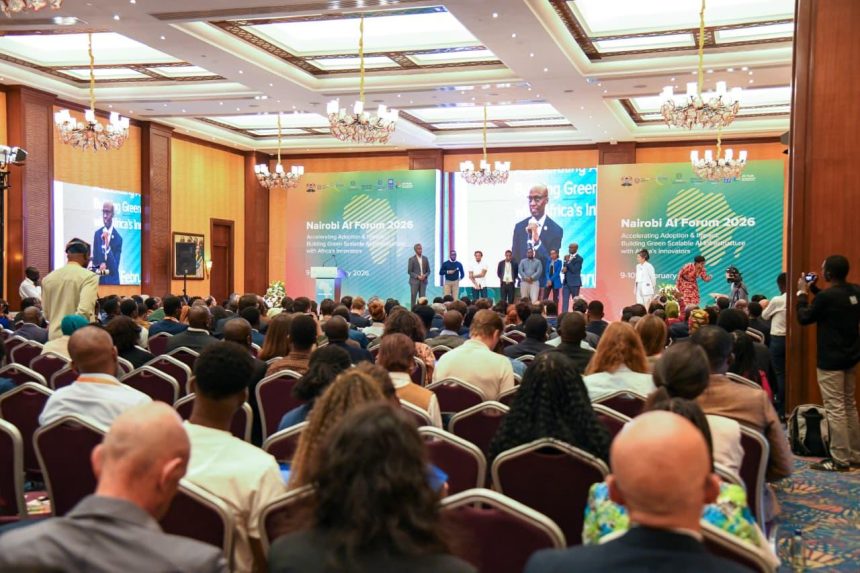
A landmark two-day summit unites 500 delegates from Africa, Europe, and the G7 — pledging 1.5 million GPU hours to African innovators and charting a new course for responsible, continent-led artificial intelligence.
By Michael Babalola | February 10, 2026 | Nairobi, Kenya
NAIROBI — When delegates from more than forty nations filed into the Nairobi AI Forum on the morning of February 9, they carried with them a shared conviction that had long been voiced but rarely acted upon: that the future of artificial intelligence cannot be written by the Global North alone. By the time the two-day summit concluded on Monday evening, that conviction had been translated into concrete commitments — and a continent that has too often been framed as a recipient of technology was, for once, positioned firmly as its architect.
The forum, co-hosted by Kenya, Italy, and the United Nations Development Programme, drew over 500 delegates representing African innovators, G7 governments, multilateral institutions, and technology companies. The headline announcement — the allocation of 1.5 million GPU hours to 130 African innovators — was described by organisers as the largest coordinated computational resource commitment ever directed specifically at Africa-based AI development.
Computing Power as a Levelling Force
Access to high-performance computing has long been cited as one of the most significant structural barriers to AI development on the continent. Training and deploying sophisticated machine-learning models demands vast processing infrastructure — resources that remain heavily concentrated in North America, Europe, and East Asia.
The partnership forged in Nairobi seeks to dismantle that bottleneck directly. Italy’s Cineca supercomputing centre, one of Europe’s most powerful research computing facilities, will contribute a significant share of the pledged GPU hours, joining cloud computing giants Amazon Web Services and Microsoft in what amounts to a trilateral commitment spanning public research infrastructure and private industry.
The 130 innovators selected to benefit from the programme are working across a range of domains that reflect the particular urgencies of life on the continent. Climate resilience technologies — tools capable of modelling erratic rainfall patterns, predicting drought cycles, and optimising agricultural yields in the face of advancing desertification — featured prominently in the cohort. So too did projects in local-language voice AI, a field whose expansion could potentially bring digital services to hundreds of millions of Africans who remain effectively locked out of systems designed around English and a handful of European languages.
Food Security and the Pragmatics of Need
Food security emerged as another priority area embedded in the forum’s commitments. Across sub-Saharan Africa, an estimated 280 million people face chronic food insecurity, a crisis compounded by conflict, climate shocks, and supply chain fragility. Forum organisers argued that AI-driven tools — from precision agriculture platforms to early-warning systems for supply disruptions — could make a material difference at scale, provided the underlying research is led by people who understand local contexts, cropping systems, and the socioeconomic conditions of smallholder farming.
This insistence on local ownership and contextual relevance was not merely rhetorical. Speakers throughout the two days returned repeatedly to the argument that AI built without African input tends to reproduce the blind spots, biases, and misaligned priorities of the societies that built it — and that deploying such systems on the continent risks entrenching, rather than redressing, existing inequalities.
Responsibility at the Core
The forum’s emphasis on “affordable, responsible AI” signals a deliberate attempt to shape the normative framing of artificial intelligence development on the continent — before, rather than after, the technology becomes deeply embedded in critical systems. Organisers and panellists stressed that Africa’s relatively nascent AI infrastructure, while a challenge in some respects, also represents an opportunity: the chance to build governance frameworks, data standards, and ethical guardrails from scratch, rather than retrofitting them onto systems already in widespread use.
The involvement of the UNDP lends the initiative multilateral credibility and ties it to the broader sustainable development agenda, providing a framework through which computational commitments can be linked to measurable human development outcomes.
A Geopolitical Dimension
The forum’s co-hosting arrangement — Kenya providing the venue, Italy channelling European and G7 engagement, and the UNDP anchoring multilateral legitimacy — reflects a carefully calibrated geopolitical architecture. For Italy, whose presidency of the G7 in 2024 made AI governance a signature issue, continued engagement with African AI development represents both a statement of values and a recognition that the global AI economy will increasingly be shaped by the size and youth of Africa’s population.
Africa’s 1.4 billion people — a figure projected to nearly double by 2050 — represent the world’s fastest-growing potential user base for AI-driven services. The continent’s innovators, if properly resourced, could become not just consumers of AI but significant producers of intellectual property, data assets, and market-specific solutions with global applicability.
From Pledge to Practice
Sceptics will note that the gap between announcement and implementation has historically been wide in international development commitments. The GPU hours must be accessed, the innovators must be supported through the deployment process, and the resulting technologies must find pathways to market and to the communities they are designed to serve.
Yet the architecture assembled in Nairobi — combining sovereign government commitment, multilateral oversight, and private sector delivery capacity — is more structurally robust than many previous initiatives. The selection of 130 innovators as concrete beneficiaries, rather than a vague commitment to support “African AI,” provides an accountability mechanism that advocates say they will monitor closely.
For now, the Nairobi AI Forum stands as the most significant international commitment yet made to African-led artificial intelligence — a signal, however it ultimately unfolds in practice, that the world’s most consequential technology race has a new and serious entrant.
© 2026 | All rights reserved | Nairobi, Kenya