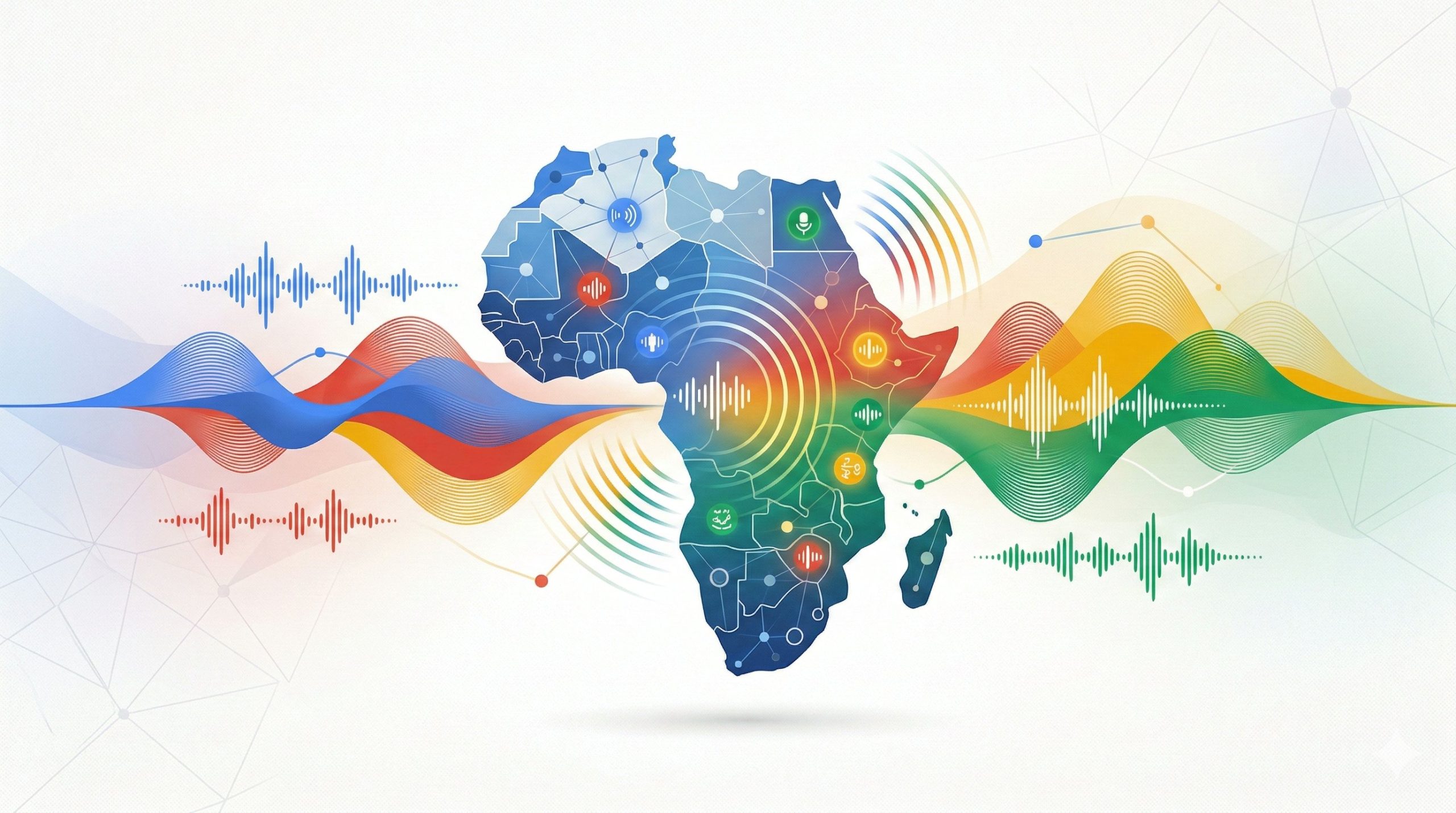
In a significant stride toward bridging the digital divide in Africa, Google Research has unveiled WAXAL, a comprehensive open-access speech dataset aimed at revolutionizing voice-enabled technologies for Sub-Saharan African languages. Named after the Wolof word for “speak,” this initiative addresses the longstanding scarcity of high-quality data for over 2,000 African languages, potentially benefiting more than 100 million speakers across the continent.
Announced on March 6, 2026, via Google’s official research channels, WAXAL comprises over 2,400 hours of speech data, including 1,846 hours of transcribed natural speech for automatic speech recognition (ASR) and 565 hours of high-fidelity recordings for text-to-speech (TTS) applications. The dataset covers 27 languages spoken in more than 26 countries, such as Acholi, Akan, Amharic, Dagbani, Ewe, Fula, Hausa, Igbo, Ikposo, Lingala, Luganda, Malagasy, Masaaba, Nyankole, Oromo, Shona, Sidama, Soga, Swahili, Tigrinya, Wolaytta, and Yoruba, among others.
This release comes at a critical time when AI technologies are increasingly integral to daily life, yet many Africans are excluded due to the lack of support for local languages in tools like virtual assistants and transcription services. “The biggest barrier for AI applications in Africa isn’t model complexity—it’s the scarcity of data for the 2000+ spoken languages there,” stated Google Research in their announcement. By providing this resource under a Creative Commons CC-BY-4.0 license, Google aims to empower local researchers, entrepreneurs, and communities to develop inclusive AI solutions.
Community-Led Data Collection: A Model for Sovereignty
What sets WAXAL apart is its community-rooted approach. The project, which began in 2021, was led by African academic and community organizations, with Google providing expertise on data collection best practices. Key partners include Makerere University (Uganda), the University of Ghana, Digital Umuganda (in collaboration with Addis Ababa University, Ethiopia), Media Trust, Loud n Clear, and the African Institute for Mathematical Sciences Senegal.
These partners retain ownership of the data, ensuring that the initiative aligns with principles of data sovereignty—a growing concern in Africa’s AI landscape. For ASR data, participants described visual stimuli to capture authentic, unscripted speech, incorporating tonal nuances and code-switching common in African languages. TTS recordings involved local teams drafting phonetically balanced scripts and using custom studio setups for quality assurance.
Aisha Walcott-Bryant, Head of Google Research Africa, emphasized the transformative potential: “The ultimate impact of WAXAL is the empowerment of people in Africa. This dataset provides the critical foundation for students, researchers, and entrepreneurs to build technology on their own terms, in their own languages.”
Mixed Reactions: Opportunities and Concerns
The launch has sparked a mix of enthusiasm and caution within Africa’s tech community. Proponents highlight its role in overcoming data bottlenecks for AI innovation. For instance, Nigerian developer Favour, who shared on X, noted that data scarcity hampered his machine learning model for detecting neonatal jaundice in African contexts, expressing hope for similar datasets in medical fields.
However, critics raise alarms about “digital colonialism.” South African academic MALATJI warned on X that such initiatives from global tech giants could undermine African data sovereignty, likening it to resource extraction. He called for continent-wide investments in AI models, pointing to leadership gaps at the African Union. Similarly, Nigerian entrepreneur Mayor of Abuja questioned the focus on language data over broader issues like education and infrastructure, urging the establishment of AI research institutes in Africa.
These concerns echo broader debates, as noted in a Rest of World report, which praised WAXAL for giving African institutions control but stressed the need for vigilance in Big Tech partnerships.
Broader Implications for Africa’s AI Future
WAXAL is already fueling derivative research, including datasets for impaired speech in Akan, benchmarks for AI models in 13 African languages, and a review of existing corpora. Experts believe it could accelerate developments in healthcare, education, and e-commerce, where voice AI can enhance accessibility in low-literacy regions.
Yet, as Toni Maraviglia highlighted on LinkedIn, the dataset’s impact extends beyond local languages to how dominant tongues like English are used in African contexts, advocating for more nuanced data collection.
Google has committed to expanding WAXAL to include more languages, positioning it as an evolving resource. For Africa, this could mark a turning point toward self-reliant AI ecosystems, provided that local stakeholders lead the charge.
The dataset is available on Hugging Face for researchers worldwide. As AI continues to reshape global societies, initiatives like WAXAL underscore the importance of inclusive, equitable innovation—ensuring that Africa’s diverse voices are not just heard, but amplified.
AI Reports Africa is dedicated to covering the intersection of artificial intelligence and African development.