
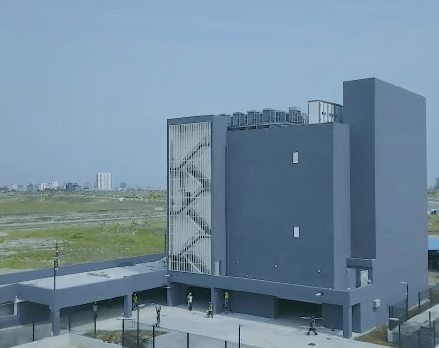
On a sprawling 42-hectare plot along the Lagos–Calabar coastal road in Lekki,
something unprecedented is rising from the Nigerian soil. Kasi Cloud’s LOS1 data centre
campus purpose-built for artificial intelligence from its very foundations is on course to
become Nigeria’s first 100-megawatt (MW) hyperscale facility, a development its
founders say will fundamentally alter Africa’s standing in the global AI economy.
Nigeria currently hosts about 17 operational data centres, none of which exceeds 20MW
of capacity. Kasi Cloud’s campus, when fully developed, will dwarf them all and in doing
so, signal that Africa is no longer content to sit at the margins of the artificial
intelligence revolution.
Designed for AI from Day One
“This is not a retrofit,” Johnson Agogbua, founder and chief executive officer of Kasi
Cloud, told journalists during a site tour in January 2026. “This was designed for AI
from day one.”
The distinction matters enormously. Traditional data centres in Lagos were built for
racks drawing 5 to 10 kilowatts of power. Kasi Cloud’s facility is engineered to support
workloads ranging from 10 to as much as 100 kilowatts per rack the range demanded by
the dense GPU clusters that power modern AI systems. Liquid cooling infrastructure
runs directly to each rack, and in some cases down to the chipset itself.
The first building is a six-storey structure housing four dedicated data halls, each
engineered for 8MW of capacity. Initial operations targeted to begin in the second
quarter of 2026 will launch with 5.5MW on a single floor, scaling upward as tenants
arrive. The entire campus holds permits for up to four such buildings, capable of
supporting 100MW of sellable power at full density.
A $250 Million Bet on Nigeria’s Tech Future
Kasi Cloud broke ground on the project in April 2022, with construction beginning in
earnest in mid-2023. The $250 million investment backed in part by the Nigeria
Sovereign Investment Authority (NSIA) is one of the most ambitious digital
infrastructure commitments ever made on African soil.
To put the scale in perspective: according to the Cushman & Wakefield Data Centre
Development Cost Guide, building a 100MW facility typically costs between $900
million and $1.5 billion globally, based on an industry average of $9 million to $15
million per megawatt. Kasi Cloud’s $250 million figure covers the initial phase a signal
of both the ambition and the phased approach the company is taking to bring the
campus online.
Agogbua did not shy away from the significance of the moment. “Why should you step
into Malaysia and see world-class, then come to Nigeria and accept less?” he asked
during the site tour. The first building remains unfinished but the trajectory, he insists,
is unmistakable.
Filling a Critical Continental Gap
The urgency behind the project is underscored by a stark global reality. Africa currently
accounts for less than 1% of announced GPU capacity worldwide. As Agogbua noted,
“The arms race is in North America, Southeast Asia and the Middle East. Africa is
largely absent.”
Hyperscale AI campuses those targeting 50MW or more of installed capacity have
become the global standard for facilities capable of running the compute-intensive
workloads that define modern innovation. Dense GPU racks drawing 50 to 150 kilowatts
apiece push overall power demand far beyond what older enterprise data centres,
typically built for 30 to 50MW, were ever designed to handle.
Nigeria’s existing 17 data centres were simply never engineered for this era. Kasi Cloud,
in Agogbua’s framing, is an attempt to correct that by building the foundational
infrastructure that will allow Nigerian and African companies to compete globally.
Infrastructure for a Digital Ecosystem
The campus is being designed as more than a single facility. Roads, drainage systems,
and fibre ducts buried at a standard depth of 1.8 metres to avoid future disruption are
being laid across the broader site. Kasi Cloud’s long-term vision is to attract tower
companies, network operators, and service providers, transforming the campus into a
self-contained digital ecosystem.
The facility has already caught the attention of GPU cloud platform UduTech and the
Alliance for AI Africa. According to Alex Tsado, founder of UduTech, Kasi Cloud is
optimised for AI GPUs and the partnership aims to offer cloud services tailored
specifically to regional demand including a model where distributed GPUs can be rented
out when not in use, generating revenue for owners while democratising access to AI
compute across the continent.
Challenges Ahead
The road ahead is not without obstacles. Building at this scale in Nigeria where supply
chains are fragile and almost all specialised equipment, from GPUs to advanced cooling
systems, must be imported exposes the project to currency volatility and logistical
delays. Power availability remains a core concern; Nigeria’s national grid has historically
struggled to deliver reliable, large-scale electricity to industrial users.
Analysts note that many similar projects across the continent remain in redesign stages,
and timelines are highly sensitive to execution risk. Still, the evidence on the ground in
Lekki is compelling. Some parts of the LOS1 facility are already operational, and
commercial onboarding is set to begin once core systems pass final testing.
A Market Poised for Rapid Growth
The broader context is encouraging. Nigeria’s data centre market was valued at
approximately $1.4 billion in 2025 and is projected to reach $2.7 billion by 2035,
representing a compound annual growth rate of around 7%. Nigeria already ranks
among Africa’s fastest-growing data infrastructure markets, with at least nine facilities
either under construction or in advanced planning stages beyond its existing 17
With installed capacity currently between 65 and 86 megawatts, industry projections
suggest Nigeria could climb beyond 400 megawatts within the next three to five years a
figure that would mark a genuine transformation in the country’s digital infrastructure
landscape.
For now, the Kasi Cloud campus in Lekki stands as the most visible emblem of that
ambition a six-storey structure built not for the internet of yesterday, but for the
AI-driven economy of tomorrow. As Agogbua sees it, Nigeria’s place in that economy
will not be determined by incremental upgrades. It will be determined by infrastructure
designed, from the very foundations up, for what comes next.