Davos, Switzerland – January 25, 2026
Artificial intelligence (AI) has the potential to dramatically reshape the global economy, potentially increasing international trade by nearly 40% and boosting global GDP by up to 13% by 2040, according to the World Trade Organization’s (WTO) latest findings. However, this transformative growth hinges on bridging digital divides and ensuring equitable access to AI technologies, particularly for developing economies.
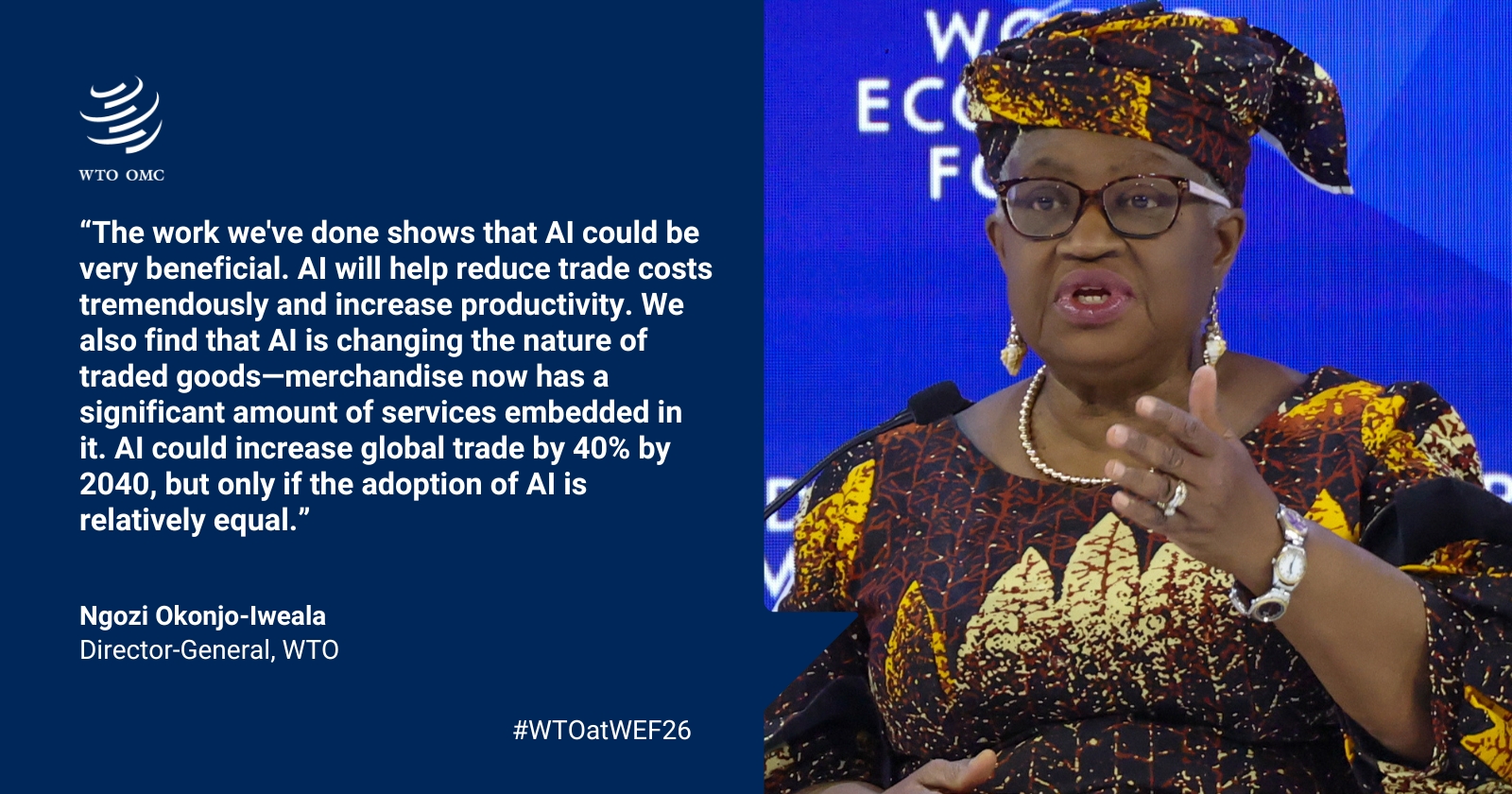
Speaking at the World Economic Forum’s Annual Meeting in Davos during the “Global Economic Outlook” session, WTO Director-General Ngozi Okonjo-Iweala emphasized AI’s role in driving inclusive growth. “The work we’ve done shows that AI could be very beneficial. AI will help reduce trade costs tremendously and increase productivity. We also find that AI is changing the nature of traded goods—merchandise now has a significant amount of services embedded in it. AI could increase global trade by 40% by 2040, but only if the adoption of AI is relatively equal,” she stated.
The projections stem from the WTO’s World Trade Report 2025, titled “Making Trade and AI Work Together to the Benefit of All,” released in September 2025. The report delves into the interplay between AI and international trade, highlighting how AI can lower barriers, enhance efficiency, and foster new opportunities in global value chains.
Mechanisms Driving AI’s Trade Impact
The report outlines several key ways AI influences trade. Primarily, AI reduces operational costs through innovations like optimized supply chain logistics, automated customs clearance, and real-time market intelligence. For instance, AI-powered translation tools have been shown to increase exports by up to 17.5% by overcoming language barriers.
Productivity gains are another cornerstone, with AI adding an estimated 0.68 percentage points to annual total factor productivity growth. This is particularly evident in services sectors, where AI enables “telemigration” and global competition in areas like software development and consulting.
A notable shift is the “servicification” of trade, where AI embeds digital services into physical goods, making them more tradable. Digitally deliverable services, including AI-generated content and analytics, could see trade growth of up to 42%. The report notes that trade in AI-enabling goods, such as semiconductors, already reached $2.3 trillion in 2023.
Challenges and the Risk of Divergence
Despite these opportunities, the report warns of significant hurdles. Global access to AI remains uneven, with high-income economies adopting the technology at rates twice that of low-income countries. Infrastructure gaps—such as broadband availability and data center distribution—exacerbate this divide, with only 2% of global data centers located in Africa.
Without intervention, AI could widen inequalities. Low-skilled workers face job displacement risks, with 17.1% of global jobs highly exposed to automation. In developing regions, informal sectors comprising 60% of the workforce are particularly vulnerable. Market concentration in AI, dominated by a few major players, further risks marginalizing smaller economies.
For developing nations, including those in Africa, the stakes are high. The report highlights potential leapfrogging opportunities, such as AI tools boosting crop yields by 35% in agriculture or closing 30% of funding gaps for micro, small, and medium enterprises (MSMEs) through better credit scoring. However, without equitable adoption, these regions could be sidelined in global value chains.
Policy Pathways for Inclusive Growth
To harness AI’s benefits, the WTO recommends a multifaceted approach. Trade policies should reduce barriers to AI-enabling goods and services, including lowering tariffs and expanding agreements like the Information Technology Agreement (ITA). Complementary measures include investments in digital infrastructure, education, and skills training—areas where high-income countries currently outspend low-income ones by significant margins.
International cooperation is crucial, with the WTO advocating for regulatory coherence, capacity-building initiatives like Aid for Trade, and frameworks to manage risks such as data privacy and energy demands. “Trade can be a powerful enabler for an inclusive AI transformation… by closing digital divides, investing in workers, and promoting regulatory coherence,” the report states.
As global leaders convene in Davos, Okonjo-Iweala’s call underscores the urgency: AI’s promise for trade-led prosperity must be matched by policies that ensure no economy is left behind. With the right actions, the report concludes, AI could drive not just growth, but inclusive and sustainable development worldwide.