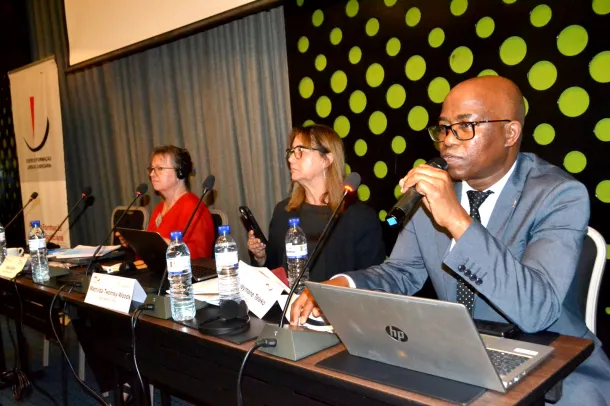
As artificial intelligence rapidly enters courtrooms across the continent, African judicial leaders are refusing to let technology outpace human rights. In a landmark regional workshop concluded this week, UNESCO and the African Network of Judicial Trainers (ANJT) brought together 31 senior judges, magistrates and directors of judicial training institutes from across Africa to confront the opportunities and dangers of AI in justice delivery.
The gathering in Maputo focused squarely on one core principle: justice must remain human-centred, especially in the digital age.
“AI is no longer a future prospect for Africa’s courts,” the workshop underscored. Tools for translation, legal research, case summarisation and even predictive analytics are already being piloted in several countries. Yet participants exchanged frank accounts of the risks: algorithmic bias that could amplify discrimination, lack of transparency when AI generates evidence, and the danger that machines might subtly erode judicial independence.
Michael Croft, UNESCO’s Regional Director in Mozambique, captured the mood: “Justice must remain human-centred, especially in the digital age.”
The workshop is the latest and most concrete step in a continent-wide push to embed human rights safeguards into AI governance for the judiciary. It builds directly on the African Union’s Continental AI Strategy, endorsed in 2024, which calls for ethical, inclusive and Africa-centric development of the technology grounded in human rights and the rule of law.
To equip judges and trainers immediately, UNESCO unveiled two practical resources developed under its AI & Rule of Law Programme:
The Guidelines for the Use of AI Systems in Courts and Tribunals (2025), which set 15 universal principles including transparency, accountability, meaningful human oversight and protection of fundamental rights. AI is positioned strictly as an assistive tool never a replacement for judicial reasoning.
AI Essentials for Judges (2026), a concise handbook that translates complex AI concepts into everyday judicial practice and helps courts design responsible governance frameworks.
Participants left Maputo with a clear commitment: adapt these global tools into national training curricula so that every judge, magistrate and court administrator across Africa receives practical guidance on using AI without compromising fairness or human dignity.
The timing is critical. Recent UNESCO data shows that 44 % of judges worldwide are already using AI for work, yet only 9 % have received formal training or institutional guidelines. In Africa, where many courts operate in multiple local languages and serve populations with limited digital
access, the stakes are even higher. Translation tools can dramatically improve access to justice for non-English or non-French speakers, but only if the underlying algorithms are free from bias and the human judge retains final authority.
The Maputo workshop follows similar UNESCO-led initiatives, including a 2025 gathering in Nairobi that brought judges from 13 African countries to examine AI’s impact on freedom of expression and the rule of law. It also aligns with broader continental conversations, such as the recent launch of the “Advancing Tech Justice in Africa” report, which highlights both progress in strategic litigation and persistent gaps in enforcement and remedies.
For ordinary Africans, the implications could be profound. Faster case resolution, better access to legal information in rural areas, and more consistent sentencing decisions are within reach provided the technology is governed by African judges, for African realities.
Yet the message from Maputo was unambiguous: innovation without safeguards is not progress. Algorithmic opacity, automation bias and the risk of replicating historical inequalities must be confronted head-on. Africa’s judicial trainers are now positioned to lead that confrontation, turning international guidelines into locally owned training programmes that multiply knowledge from Cape Town to Cairo.
As one participant summarised the shared determination: the goal is not to resist AI, but to shape it so that it strengthens rather than undermines the fundamental right to a fair trial.
With national adaptations of the UNESCO resources already underway, Africa’s judiciaries are sending a clear signal: technology will serve justice, not the other way around. For millions of Africans who look to the courts for protection of their rights, that commitment could prove transformative.