A new policy imperative emerges as African entrepreneurs transform AI from buzzword to business lifeline—if structural obstacles don’t derail them first
Across Africa’s agricultural heartlands, financial districts, healthcare clinics, and logistics hubs, a quiet revolution is unfolding. Small and medium enterprises are wielding artificial intelligence not as a futuristic luxury but as a survival tool—predicting crop diseases before they devastate harvests, extending credit to the unbanked, and coordinating complex supply chains with algorithms that outpace human capacity.
Yet this grassroots innovation surge faces a formidable adversary: the very structural barriers that have long constrained African business development. A growing chorus of researchers, policymakers, and entrepreneurs now argues that without deliberate policy intervention to remove these obstacles, the continent risks squandering its most promising pathway to AI adoption and economic transformation.
The Stakes: A $180 Billion Opportunity—Or a Missed Chance
Digital technologies led by AI could inject $180 billion into Africa’s economy by 2030, according to the African Development Bank. But the path to capturing this value runs directly through the continent’s SMEs—businesses that account for 80 percent of employment and 90 percent of all enterprises across the region.
These aren’t marginal players. In Kenya alone, SMEs contribute 40 percent of GDP. Yet they face a staggering $331 billion credit shortfall, with only 20 percent accessing formal finance compared to 50 percent in Asia. Meanwhile, Africa contributes less than 1 percent of global AI research and development, even as its entrepreneurs demonstrate remarkable ingenuity in applying the technology to local challenges.
The disconnect is stark: African SMEs are ready to use AI. The question is whether policy frameworks can catch up to entrepreneurial momentum before the window closes.
Four Sectors, Countless Barriers
The urgency for policy reform becomes clearer when examining how AI is already reshaping Africa’s core economic sectors—and where it’s being held back.
Agriculture: Innovation Despite Infrastructure
In Ghana, the Farmerline platform has boosted agricultural productivity by 30 percent by providing farmers with real-time weather data and market information through AI-powered tools. Kenya’s Apollo Agriculture uses machine learning to help smallholder farmers spot crop diseases early and optimize irrigation. Tanzania’s Virtual Agronomist delivers agronomic advice via AI chatbots, bridging the gap left by insufficient extension services.
These successes mask deeper challenges. Only 40 percent of African SMEs use digital tools for record-keeping, according to the African Development Bank’s 2025 report. Proprietary software comes with vendor lock-ins and subscription fees that run approximately 35 percent higher in Africa than elsewhere. When vendors fail or change terms, farmers and agribusinesses lose access to critical data—sometimes forcing manual re-entry of thousands of records by hand.
The infrastructure deficit is even more fundamental: nearly 40 percent of Africans lack internet access, concentrated heavily in rural farming communities where AI could deliver the greatest impact on food security.
Finance: Democratizing Credit Through Data
AI-driven credit scoring is transforming financial inclusion across the continent. In Nigeria, startups like Indicina leverage machine learning to automate credit assessments, expanding SME loan access. Kenya’s M-Pesa processes $300 billion annually, lifting 2 percent of the country’s GDP, while integrating AI to refine financial services.
The innovation is clear: AI can evaluate creditworthiness using alternative data—transaction histories, mobile money patterns, even agricultural yields—enabling microloans for populations that traditional banking systems exclude. Yet the promise remains partially fulfilled. Many SMEs still lack the technical expertise to integrate these systems, while fragmented data protection laws across African nations create compliance nightmares for fintechs attempting to operate regionally.
Healthcare: Bridging the Urban-Rural Divide
AI is closing critical gaps in healthcare delivery. Rwanda’s deployment of AI-powered chatbots and diagnostic models through platforms like Babylon has improved healthcare access for millions in rural areas. Nigeria’s Ubenwa uses AI to analyze newborn cries for early signs of birth asphyxia, a major cause of infant mortality. Ghana’s mPharma applies AI to pharmaceutical supply chain management, reducing counterfeits and ensuring medicine availability.
According to the World Health Organization, AI-enabled diagnostics could increase access to basic healthcare by up to 45 percent in underserved areas. Yet scaling these solutions confronts the same infrastructure constraints that plague other sectors: unreliable electricity, limited high-speed internet, and acute shortages of skilled professionals who can maintain and adapt AI systems to local contexts.
Logistics: Coordinating Complexity
Cross-border trade in Africa presents unique challenges that AI is beginning to address. Startups like Kenya’s DeepRoute develop AI-powered logistics algorithms to reduce fuel waste and delivery delays. Companies like Ridelink are using AI to coordinate fragmented supply chains—connecting freight forwarders, customs brokers, and transporters while offering embedded financing based on shipment data.
The impact is tangible: Ridelink reports zero defaults on its AI-driven trade credit, enabling SMEs without bank credentials to access working capital in hours rather than weeks. Yet these successes highlight rather than resolve the underlying problem. Once goods move into overland transport across African borders, end-to-end visibility becomes patchy. The scale of trade finance African SMEs need remains massively undersupplied.
The Barrier Breakdown: What’s Actually Holding SMEs Back
Research consistently identifies five interconnected obstacles preventing African SMEs from fully embracing AI:
Infrastructure Deficits: Unreliable electricity and limited high-speed internet connectivity, particularly in rural and peri-urban areas, make cloud-based AI solutions inconsistent or inaccessible. Africa’s digital infrastructure investment needs dwarf current spending.
Skills Shortages: A significant portion of the African workforce lacks basic digital literacy, let alone the advanced capabilities required for AI implementation. The skills gap creates barriers not just for individual businesses but for broader economic development, limiting innovation and competitiveness.
Financial Constraints: The $331 billion financing gap facing African SMEs manifests acutely in technology adoption. High costs for AI tools, lack of access to patient capital, and risk-averse financial institutions all compound to make AI investment prohibitively expensive for most small businesses.
Data Fragmentation: Inconsistent data collection, poor record-keeping practices, and lack of standardized reporting scare off investors and make it difficult to train AI models on local conditions. Many policies addressing data governance are developed by international organizations rather than locally, creating misalignment with on-the-ground realities.
Regulatory Ambiguity: Many African countries lack comprehensive AI policies addressing data privacy, algorithmic bias, and accountability. While this policy vacuum hasn’t stopped entrepreneurial experimentation, it creates uncertainty that deters larger-scale investment and leaves SMEs vulnerable to regulatory whiplash when frameworks eventually emerge.
The Policy Imperative: Five Urgent Actions
The research literature converges on a clear set of policy interventions needed to unlock SME-led AI innovation:
1. Strategic Infrastructure Investment
Governments must prioritize expansion of reliable electricity and high-speed internet access, particularly in rural areas, through public-private partnerships. Creating innovation hubs and tech parks can provide SMEs with shared access to computing resources, reducing individual cost burdens. The model should move beyond traditional infrastructure to embrace AI-specific needs like cloud computing hubs that address data sovereignty concerns.
2. Targeted Skills Development
Training programs must enhance technical capabilities across the SME workforce, focusing on practical AI implementation rather than abstract theory. This means integrating emerging technologies into post-primary curricula, expanding distance learning opportunities, and creating worker-centered reskilling programs that build capability rather than simply displacing workers.
3. Innovative Financing Mechanisms
Financial institutions should develop tailored funding solutions specifically for SMEs adopting AI technologies. This includes tax incentives, grants, risk-sharing mechanisms, and patient capital structures that recognize the longer-term payoffs of technology investments. Regulatory frameworks should facilitate rather than obstruct fintech innovations that expand credit access.
4. Data Governance and Access
Policymakers should promote publicly available datasets that local entrepreneurs can leverage to create local solutions. This requires investment in local language data, participatory data collection approaches, and clear guidance on data sharing that balances privacy protection with innovation needs. Harmonized regional frameworks would reduce compliance complexity for SMEs operating across borders.
5. Adaptive Regulatory Frameworks
Anticipatory regulatory approaches must foster thriving marketplaces for emerging technologies while addressing ethical concerns around inequality, bias, and accountability. Regulatory sandboxes allow SMEs to experiment with AI applications in controlled environments. Crucially, frameworks should be developed with African input and perspectives, not simply imported from other contexts.
The Bottom-Up Revolution Continues—With or Without Policy Support
What makes the current moment distinctive is that African SMEs are not waiting for permission. In Kenya, Nigeria, South Africa, and beyond, entrepreneurs are elbow-deep in practical experimentation, moving from proof-of-concept pilots to scalable platforms. The innovation is contagious—tactics pioneered in agriculture are spreading to energy, logistics, and informal retail.
Yet this organic growth carries risks. Without supportive policy frameworks, the current wave of innovation could fragment rather than scale, leaving successful experiments trapped as isolated cases rather than catalysts for broader transformation. The specter of high-profile agtech failures—iProcure, WeFarm, GroIntelligence—looms as a warning of what happens when business models outpace supporting infrastructure and policy.
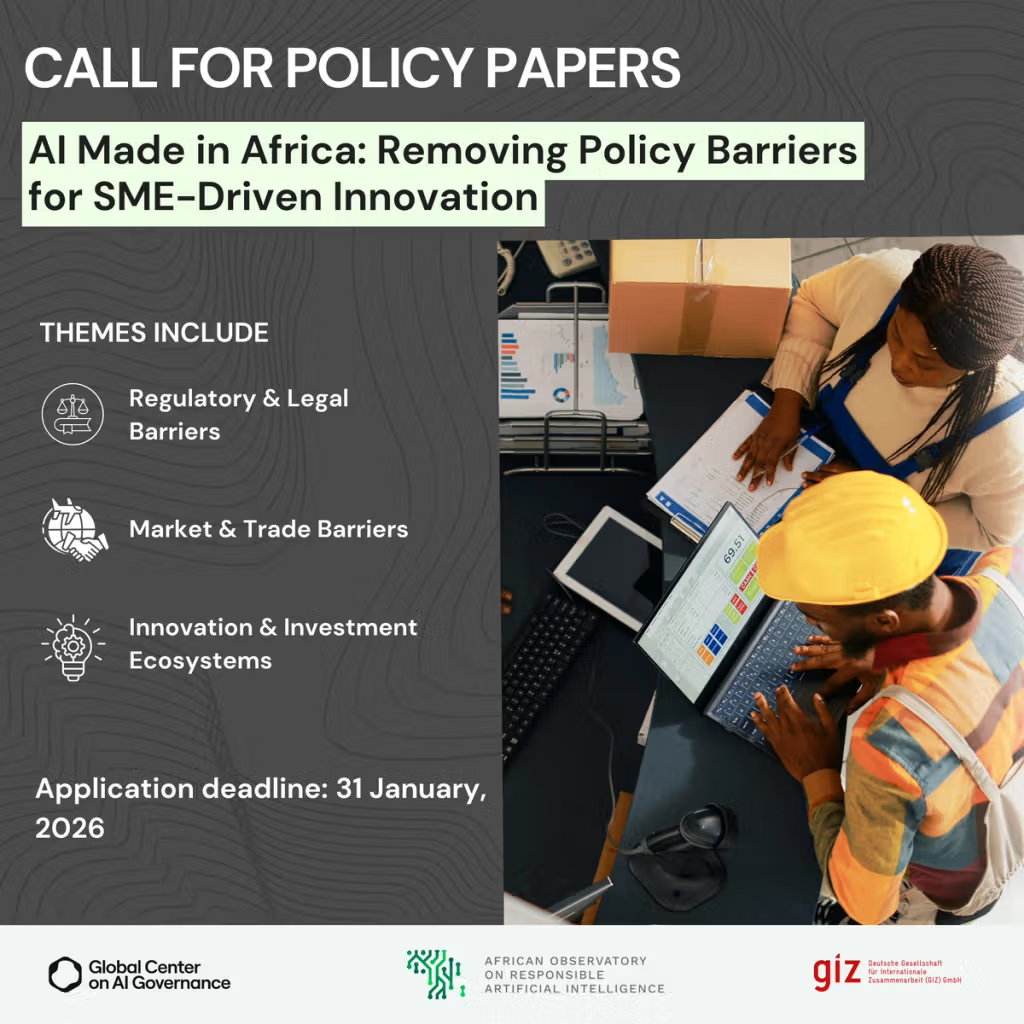
The call for policy papers on SME barriers to AI adoption is more than an academic exercise. It represents recognition that Africa’s AI future will not be determined by government labs or multinational corporations but by the small and medium enterprises already proving that AI can solve real African problems—crop failures, credit exclusion, healthcare gaps, logistical chaos.
The question is whether policymakers will clear the path or continue to leave entrepreneurs navigating obstacle courses. Given the stakes—hundreds of billions in economic value, millions of jobs, food security, healthcare access—the urgency of action has never been clearer.
Africa’s SME-led AI revolution is happening. Now comes the hard part: building the policy infrastructure to sustain it.
Click here to apply