AI in African Eyecare: 26.3 Million Lives Hang in the Balance
How artificial intelligence is transforming vision care across Africa—and the critical challenges threatening its success
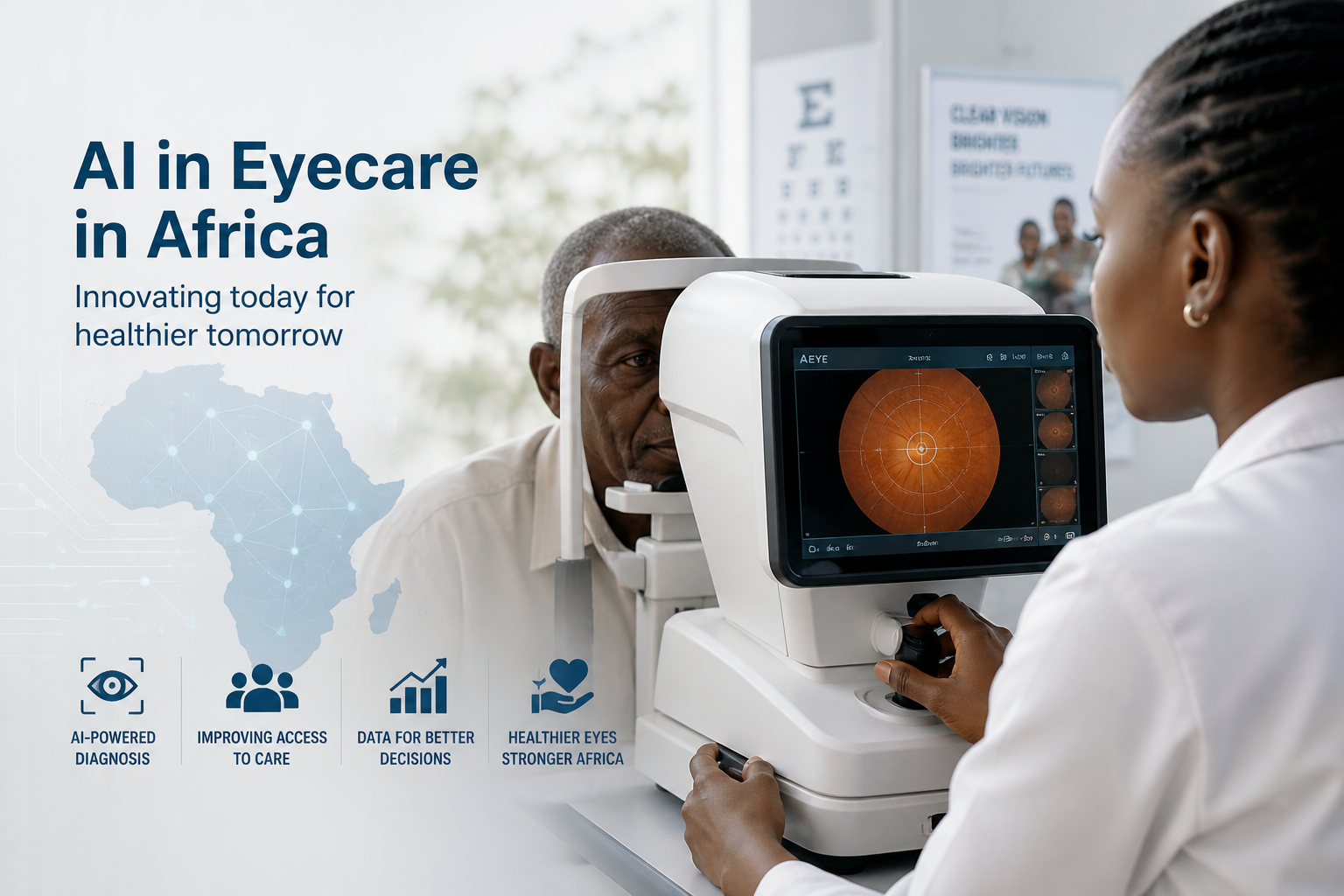
In a diabetes clinic in Kigali, Rwanda, a patient receives life-changing news in real-time. An AI system has analyzed their retinal scan and detected early signs of diabetic retinopathy—a condition that, left untreated, leads to irreversible blindness. But because the diagnosis came immediately, not days later, this patient is significantly more likely to attend their follow-up appointment and save their sight.
This isn’t a pilot program or proof-of-concept. It’s happening right now, at scale, across Africa. And it needs to happen much faster.
The stakes: Approximately 5.9 million Africans are currently blind, with another 20.4 million experiencing moderate to severe visual impairment. Up to 80% of this blindness is preventable or treatable with current technology. Yet millions remain without access to basic eye care services.
The Workforce Crisis Nobody’s Talking About
The numbers are stark. Sub-Saharan Africa has an average of 2.5 ophthalmologists per million people—dramatically below the WHO-recommended minimum of 4 per million, and catastrophically short of the 80 per million in high-income countries like the United States.
This translates to one ophthalmologist for every 446,000 people on average. In some countries, the ratio drops to one per million.
Mathematical modeling reveals an impossible situation. Without transformative intervention, this gap will persist indefinitely.
The Emerging Threat: A Diabetes Explosion
While Africa makes progress against communicable diseases like trachoma and onchocerciasis, non-communicable age-related conditions—particularly diabetic retinopathy—are rapidly increasing.
Africa faces the largest projected increase in diabetes cases globally: 143% by 2045. This means more than 21 million adults in sub-Saharan Africa will have diabetes by 2045, up from fewer than 9 million in 2019.
Diabetic retinopathy is the leading cause of vision loss among working-age people globally. Anyone with diabetes is at risk. Yet early diagnosis and treatment through screening can reduce vision loss by 98%.
The problem? Screening programs are nearly impossible to implement effectively with current workforce levels.
AI Solutions: What’s Actually Working
🇷🇼 Rwanda: The Cybersight AI Breakthrough
Orbis International’s study in Rwanda represents the first globally to explore AI for diabetic retinopathy screening and referral uptake in a clinical setting. The results are remarkable:
- 99%+ patient satisfaction with AI screening
- 63% of participants preferred AI over human graders
- Significantly higher follow-up attendance when receiving immediate AI feedback vs waiting 3-5 days for human reports
- 823 participants screened during routine diabetes clinic visits
The key insight: Integration into existing workflow at diabetes clinics meant patients received eye exams during their routine appointments—eliminating separate visits, saving time and travel costs, and dramatically improving adherence.
📱 Peek Vision: Smartphone-Based Screening at Scale
Peek Vision has reached a milestone of connecting one million people to eye care through its technology. Partner organizations have screened more than 10 million people using Peek across 12 countries in Africa and Asia.
Zimbabwe Case Study:
- Refractive error cases at provincial hospital reduced from 18.6% to 4.0% of caseload
- Cataract cases increased from 30% to 50%—reflecting more appropriate use of specialist resources
- Most minor cases now treated at primary and secondary level
Botswana Scale: Government partnership for national school eye health programme screened over 120,000 schoolchildren in 2016 pilot with 90% follow-up attendance.
How AI Is Changing Eyecare Delivery
- Automated Diabetic Retinopathy Screening: AI analyzes retinal images to detect early signs, enabling intervention before irreversible damage occurs
- Task-Shifting: Nurses and qualified healthcare personnel conduct screenings effectively, dramatically increasing capacity
- Telemedicine Integration: Remote consultations connect patients in remote areas with specialists
- Predictive Modeling: AI predicts progression of diabetic retinopathy, glaucoma, and myopia to guide treatment
- Multi-Disease Detection: Single platforms screen for multiple eye conditions simultaneously
The Hidden Danger: Data Bias
Critical Challenge: Most AI algorithms used in eyecare have been trained primarily on datasets from European or East Asian populations, resulting in reduced accuracy when applied to patients of African ancestry.
This isn’t a theoretical concern—it’s a documented problem affecting diagnostic accuracy:
- More data is gathered in Europe than in Africa despite Africa’s larger population
- Algorithms trained on European or East Asian faces demonstrate reduced accuracy for African phenotypes
- Studies have documented bias even in seemingly straightforward tasks like brain segmentation
- Africa’s contribution to publicly available medical imaging datasets remains disproportionately low
Some estimates suggest that as much as 60% of data used to train AI will be synthetic by 2024. But synthetic data cannot solve the representation problem—you cannot use an underrepresented African dataset to create synthetic African data to augment that same underrepresented dataset. The representation dilemma becomes circular.
The Infrastructure Gap
Successful AI deployment depends on robust technological infrastructure:
- Limited Internet Connectivity: Cloud-based diagnostic systems cannot reach remote areas without adequate infrastructure
- Equipment Costs: Advanced imaging systems represent significant capital investments beyond many facilities’ reach
- Power Supply Reliability: Inconsistent electricity disrupts digital health systems
- Digital Literacy: Healthcare workers often lack smartphone literacy, requiring extensive training
The Regulatory Vacuum
A comprehensive review of 12 African countries found no AI-specific regulatory instruments at either regional African level or in individual countries.
While approximately 36 of 54 African countries have established data protection regulations, and the African Union has advanced its Continental AI Strategy, only seven African nations (Benin, Egypt, Ghana, Mauritius, Rwanda, Senegal, and Tunisia) have drafted national AI strategies as of 2023.
This creates uncertainty around:
- Patient data ownership and usage rights
- Cross-border medical data transfer
- Liability for AI system errors
- Algorithmic transparency requirements
The Path Forward: What Must Happen Now
1. Build African-Centered Datasets
Establish large, carefully-curated, publicly available datasets representing African populations across diverse ethnic groups, ages, and disease presentations. Mandate validation of all AI systems on African population datasets before deployment.
2. Develop Africa-Specific Regulatory Frameworks
Create regulatory frameworks adapted to African contexts, priorities, and resource constraints. Implement algorithmic impact assessments requiring systematic evaluation for potential harms and biases.
3. Expand Infrastructure Strategically
Deploy lightweight edge computing solutions for instant feedback in resource-constrained settings. Invest in high-speed internet and reliable power while prioritizing mobile-first solutions that leverage existing infrastructure.
4. Ensure Human-Centered Implementation
Position AI as a tool to enhance clinician capabilities, not substitute for human judgment. Provide comprehensive training and maintain systematic outcome tracking to ensure AI improves rather than compromises care quality.
5. Create Sustainable Financing
Structure public-private partnerships to share costs and expertise. Implement social impact licensing requiring technology companies to provide free or subsidized services to underserved populations as a condition of market access.
The Window Is Closing
With diabetes rates exploding, workforce shortages persisting, and proven AI solutions available, delay costs lives and vision. But deployment must proceed responsibly—with African voices driving development, African data training algorithms, and African contexts shaping implementation.
Download Full Report (PDF)Conclusion
Artificial intelligence represents a critical intervention point in Africa’s eyecare crisis. The evidence from Rwanda, Zimbabwe, Kenya, Botswana, and other African nations demonstrates that AI-powered screening and diagnostic systems work. Patient satisfaction exceeds 99%, screening throughput reaches 1,000+ cases per day, and follow-up attendance improves significantly.
Programs like Peek Vision have already connected one million people to care by screening over 10 million across 12 countries. This is not theoretical—it’s happening.
However, realizing AI’s full potential requires confronting serious challenges: algorithmic bias from underrepresented African populations in training datasets, infrastructure gaps, underdeveloped regulatory frameworks, and prohibitive costs.
Done right, AI in eyecare can help Africa leapfrog traditional development pathways, delivering world-class diagnostic services even in the most remote villages.
The technology works. The challenge now is ensuring it works for everyone.
Share This Investigation
Sources & Methodology
This investigation draws on peer-reviewed research, organizational reports, and institutional data from:
- Orbis International Rwanda diabetic retinopathy studies (Ophthalmology Science, British Journal of Ophthalmology)
- Peek Vision impact studies across Kenya, Botswana, Zimbabwe, Ethiopia, Tanzania, and Uganda
- World Health Organization African Region eye health statistics
- London School of Hygiene and Tropical Medicine – International Centre for Eye Health research
- Google Health AI initiatives and published research
- African Union Digital Transformation Strategy and AI policy documents
- Global Burden of Disease Study – Vision Loss Expert Group
Complete citations and data available in the full report.
Want More Investigative Reporting on AI in Africa?
Subscribe to AI Reports Africa for in-depth analysis, data-driven investigations, and exclusive interviews with the people building Africa’s AI future.
Subscribe to Newsletter