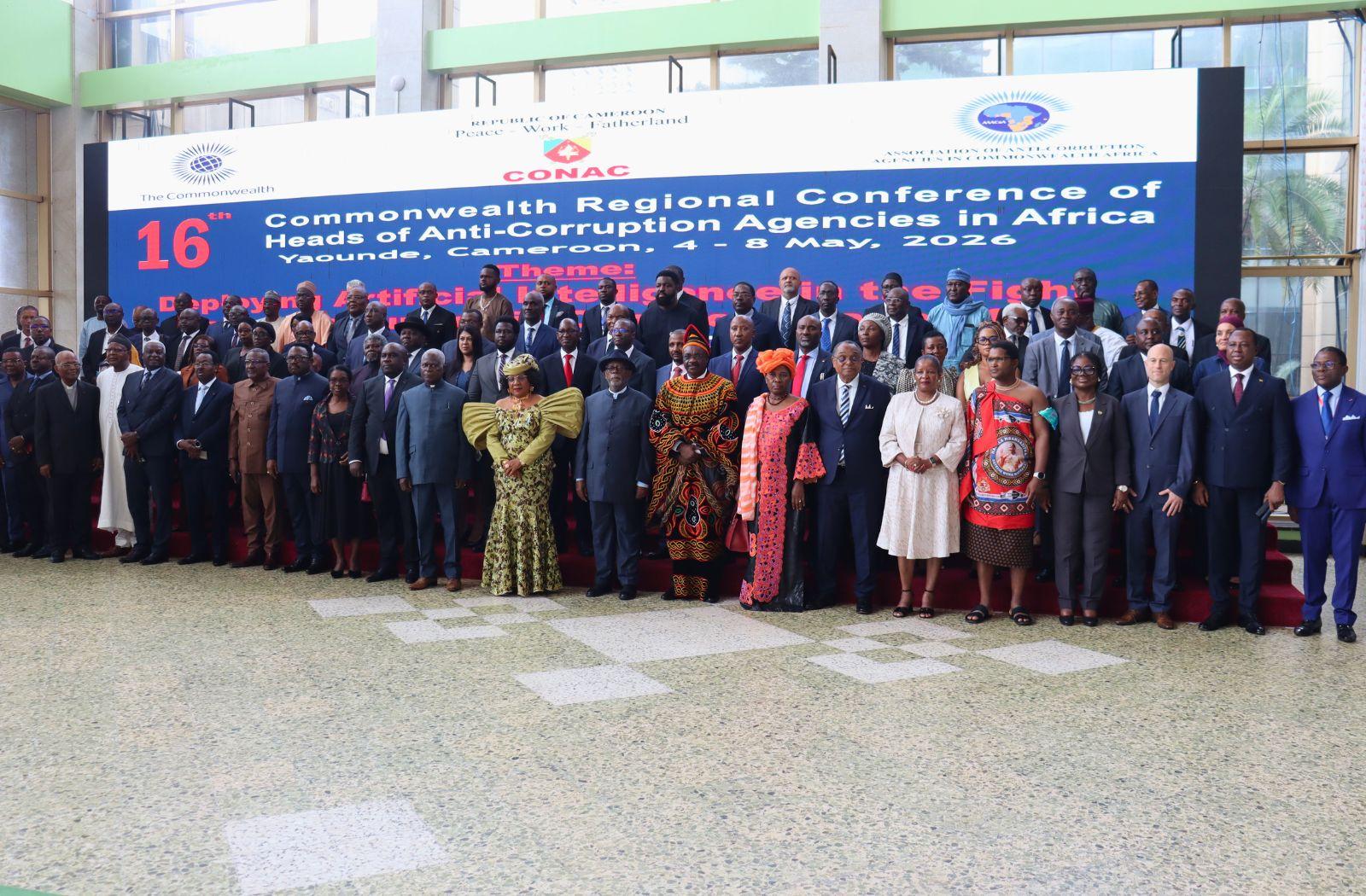
More than 200 anti-corruption leaders, policymakers, and international experts from across Commonwealth Africa gathered in Cameroon’s capital from May 4 to 8, 2026, for a landmark conference that positioned artificial intelligence as a critical new weapon in the continent’s battle against graft.
The 16th Commonwealth Regional Conference of Heads of Anti-Corruption Agencies in Africa, hosted by Cameroon’s National Anti-Corruption Commission (CONAC) in partnership with the Commonwealth Secretariat, centered on the theme: “Deploying Artificial Intelligence in the Fight Against Corruption in Commonwealth Africa.”
Participants from over 20 countries explored how AI can enhance investigations, data analysis, risk detection, fraud prevention, and public sector oversight. Sessions examined both the transformative potential of these technologies and the risks they pose, including data privacy concerns and the potential for malicious use.
Highlighting the Scale of the Challenge
Cameroonian officials opened the conference by underscoring the heavy economic toll of corruption. Recent figures indicated that corrupt practices cost the Cameroonian state alone more than four billion FCFA (roughly several million USD) in 2024.
Across the continent, corruption continues to undermine development, weaken institutions, and erode public trust. Conference speakers described AI as offering new capabilities—such as real-time pattern detection in procurement data, automated red-flag identification in financial transactions, and predictive analytics for high-risk areas—that traditional methods have struggled to achieve at scale.
Nigeria’s Independent Corrupt Practices and Other Related Offences Commission (ICPC) showcased its Constituency and Executive Projects Tracking Initiative (CEPTI), a technology-driven platform that has helped track trillions of naira in public projects. The presentation highlighted how data analytics and AI elements can improve transparency in infrastructure spending.
Key Outcomes: The Yaoundé Declaration
At the conclusion of the conference on May 8, delegates adopted the Yaoundé Declaration, which outlines a nine-point agenda for 2026–2027. Priorities include “weaponizing AI” for fraud detection and evidence gathering, strengthening cross-border collaboration, building capacity for anti-corruption personnel in AI tools, and improving asset recovery frameworks.
Rev. Dr. Dieudonné Massi Gams, Chairman of CONAC, was elected as the new Chair of the Association of Anti-Corruption Agencies in Commonwealth Africa (AAACoA), succeeding South Africa. Kenya is slated to host the 17th edition of the conference in 2027.
Speakers repeatedly emphasized that technology alone is not a silver bullet. Human integrity, strong institutions, and ethical governance remain essential. As one participant noted, “AI offers new tools, insights, and opportunities… but integrity will outpace corruption only when paired with committed leadership.”
Broader Context and Next Steps
The Yaoundé conference builds on growing momentum across Africa to integrate digital tools into governance. From project tracking systems to AI-assisted audits, anti-corruption agencies are increasingly looking to technology to close enforcement gaps.
Observers see the event as a signal that Commonwealth African nations are moving from discussion to actionable strategies on AI adoption—while aiming to address digital divides, data sovereignty, and capacity challenges unique to the region.As Africa grapples with rapid technological change, the Yaoundé Declaration may mark an important step toward more proactive, data-driven anti-corruption efforts. Implementation in the coming year will determine whether the ambitious vision translates into measurable reductions in graft.