
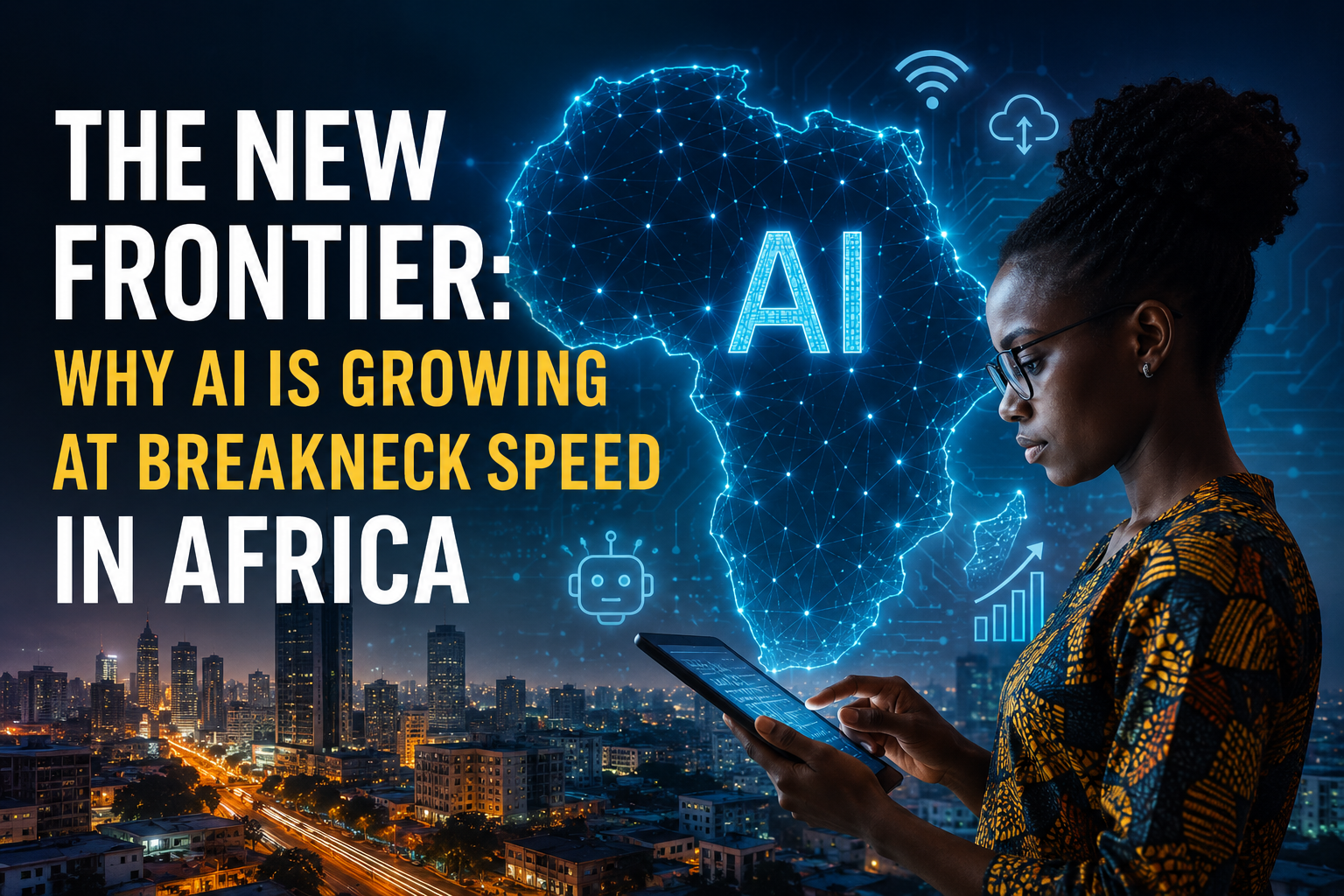
From Leapfrog to Leadership: The Continent Racing to Redefine Its Digital Future
Lagos, Nigeria — In a small office in Lagos’s bustling Yaba district, a team of engineers is building something extraordinary. Their AI-powered platform doesn’t just replicate Western technology; it solves uniquely African problems—authenticating pharmaceuticals, predicting crop yields in unpredictable climates, and extending credit to millions who’ve never seen the inside of a traditional bank. This is the new face of African innovation, and it’s moving at unprecedented speed.
Across the continent, artificial intelligence is not just arriving—it’s exploding. The AI market in Africa is projected to grow by 28.34% annually through 2030, reaching a market volume of $16.53 billion. More striking still, AI is expected to add $1.5 trillion to the African economy by 2030 if the continent captures just 10% of the global AI market. These aren’t distant projections; the transformation is already underway, reshaping everything from healthcare to agriculture, fintech to governance.
But what’s driving this remarkable acceleration? Why is Africa, a continent long associated with playing catch-up in technological development, now positioning itself at the forefront of the AI revolution?
The Perfect Storm: Necessity, Youth, and Ambition
The answer lies in a convergence of factors that make Africa uniquely positioned for rapid AI adoption. Unlike developed nations that must retrofit AI into legacy systems, Africa has the advantage of building from scratch—or as tech analysts call it, “leapfrogging.”
“Africa has the world’s youngest population, with a median age of just 19.7 years,” explains technology researcher Jane Munga. This demographic dividend translates into a workforce hungry for digital skills and unencumbered by outdated technology mindsets. In 2022, the continent boasted the world’s fastest-growing developer community, with GitHub reporting a 40% year-on-year increase in open-source repository creation.
The numbers tell a compelling story. There are now over 2,400 AI-focused companies in Africa, including 726 in South Africa, 456 in Nigeria, and 204 in Kenya. As of late 2024, AI-focused companies attracted about 13% of venture funding for tech startups across Africa, putting AI neck-and-neck with traditionally hot sectors like fintech and cleantech.
Policy Momentum: From Strategy to Sovereignty
Perhaps nothing signals Africa’s commitment to AI more than the policy revolution sweeping the continent. The year 2024 was pivotal, with six AI-specific documents published—five at the national level by Ethiopia, Libya, Mauritania, Nigeria, and Zambia, and one continental strategy by the African Union. The momentum hasn’t slowed. In the first quarter of 2025 alone, Côte d’Ivoire, Kenya, and Namibia published national strategies, while Lesotho and Tanzania released draft strategies.
These aren’t merely aspirational documents. They represent a continent-wide recognition that AI is essential to economic competitiveness. In April 2025, African leaders converged on Kigali, Rwanda, for the inaugural Global AI Summit on Africa—a watershed moment that produced the Africa Declaration on Artificial Intelligence, endorsed by 49 African countries.
The key question African leaders are asking is no longer whether Africa will adopt AI, but how it can do so in a way that safeguards its sovereignty, generates value for local enterprises, and empowers its people. This shift from passive adoption to active ownership marks a fundamental transformation in how the continent approaches technology.
Innovation from the Ground Up
The AI startups emerging from Africa aren’t just copying Silicon Valley playbooks—they’re solving problems that global tech giants have largely ignored.
Take RxAll, a Nigerian startup using AI and spectroscopy to combat counterfeit pharmaceuticals, a problem that kills hundreds of thousands of Africans annually. Or Shamba Records in Kenya, an AI-powered platform empowering over 50,000 farmers with smart credit and climate-resilient agriculture insights. These solutions emerge from lived experience, not market research.
In October 2025, Gebeya, an Ethiopian software company, launched Gebeya Dala, an AI app builder designed specifically for the African context, addressing language barriers, payment challenges, and device constraints that plague global coding tools. Meanwhile, Tunisian founders Karim Jouini and Jihed Othmani launched Thunders, an AI-powered software testing platform that’s attracting global attention.
The diversity of innovation is staggering. By 2025, more than 75% of young Africans used AI tools weekly, reflecting strong engagement and digital readiness. From fintech using AI for credit scoring to healthtech deploying AI diagnostics, African entrepreneurs are demonstrating that local problems can inspire global solutions.
Infrastructure: Building the Foundation
For years, Africa’s digital ambitions were constrained by inadequate infrastructure. That’s changing rapidly. In 2025, Google officially launched its Johannesburg cloud region following an investment of nearly $148 million, while Microsoft announced plans to invest around $300 million to expand its cloud and AI infrastructure in South Africa by 2027.
Africa’s data center market construction sector was valued at $1.26 billion in 2024 and is projected to reach $3.06 billion by 2030, with a compound annual growth rate of 15.94%. Nigeria is leading the charge with plans for a 100 MW hyperscale data center, while South Africa is developing what’s being called Africa’s first AI factory.
The telecommunications sector is also stepping up. MTN Group, Africa’s leading mobile operator, is in advanced talks with American and European technology firms to roll out a new generation of AI-ready data centers across the continent. These aren’t just storage facilities—they’re compute-driven ecosystems designed to power machine learning and advanced analytics.
Google has invested $17 million in African universities and research institutions over the past four years and is committing an additional $9 million in the coming year. The tech giant has also expanded Google Translate to cover 110 new languages, more than 30 of which are African, with plans for datasets and voice models spanning over 50 African languages in 2026.
The Talent Paradox: Growth Amid Gaps
Yet for all this progress, Africa faces a critical challenge that threatens to constrain its AI ambitions: a severe shortage of skilled AI professionals.
Africa currently houses only 3% of the global AI talent pool. Over 83% of AI startup funding in Q1 2025 went to Kenya, Nigeria, South Africa, and Egypt, highlighting how innovation remains highly concentrated in just a few countries.
The statistics are sobering. All organizations surveyed in a recent report expect the demand for AI skills to increase in 2025, with every organization also expecting an AI-related skills gap. Nearly 90% report that AI skills shortages are already causing delays in implementations, failed innovation initiatives, an inability to take on new work, and loss of clients.
The problem isn’t just quantity—it’s also quality and distribution. A World Bank survey of 174 African universities found that only 31% offer dedicated AI programs, and 34% offer data science degrees. Machine learning engineers, natural language processing specialists, MLOps professionals, and AI researchers remain scarce and highly sought after.
Some African startups are addressing this gap creatively. In the short term, African startups are increasingly turning to Asia to address the structural shortage, outsourcing advanced engineering while maintaining control of local markets. It’s a pragmatic solution that allows companies to launch and scale while local talent pipelines develop.
Sector-Specific Transformation
The impact of AI is being felt across virtually every sector of African economies.
Financial Services: AI adoption in Africa’s payments and e-commerce markets in 2025 is expanding rapidly, with fintech and e-commerce leading AI integration through applications in fraud detection, automation, and personalized customer experiences. Mobile money platforms like M-Pesa, which processes $314 billion annually, are increasingly AI-powered.
Healthcare: Startups are deploying AI for diagnostics, drug authentication, and telemedicine, addressing the continent’s chronic shortage of healthcare professionals. AI-powered health platforms are bringing specialist-level diagnosis to remote villages.
Agriculture: With 60% of Africa’s population engaged in agriculture, AI applications in crop prediction, climate adaptation, and market access are transforming food security. Platforms are using satellite imagery and machine learning to provide precise yield forecasts and early pest detection.
Education: From adaptive learning platforms to AI tutors that speak local languages, technology is addressing Africa’s educational challenges at scale.
The Road Ahead: Opportunities and Obstacles
Africa’s AI trajectory is not without challenges. Beyond the talent gap, issues of data privacy, algorithmic bias, and digital infrastructure inequality loom large. The concentration of AI investment and development in a handful of countries risks creating new digital divides within the continent.
Energy reliability remains a concern—data centers and AI infrastructure require consistent power, which many African nations still struggle to provide. Internet penetration, while growing, is still far from universal. The continent also grapples with questions of data sovereignty and ensuring that AI development serves African interests rather than merely extracting value for foreign companies.
Yet the momentum is undeniable. Africa is poised to leapfrog other regions to capitalize on generative AI’s transformative potential. The continent’s challenges are becoming its competitive advantages—mobile-first infrastructure, young digital-native populations, and problems that demand innovative solutions.
A New Chapter in Development
What’s happening in Africa challenges long-held assumptions about technology development. Rather than waiting for developed nations to create solutions and then adapting them, African entrepreneurs, policymakers, and engineers are building from the ground up—creating AI systems that work in low-connectivity environments, support multiple indigenous languages, and address problems unique to African contexts.
The story of AI in Africa isn’t about catching up—it’s about charting a different path. As one Kenyan AI entrepreneur put it: “We’re not trying to become the next Silicon Valley. We’re building something better suited to our reality, and in doing so, we might just create solutions the rest of the world needs.”
With investments pouring in, policies aligning, and a generation of young Africans embracing AI tools and careers, the continent is writing its own script for the digital age. Whether Africa captures that projected $1.5 trillion in economic value by 2030 will depend on how successfully it navigates the challenges ahead—but the race is well and truly on.
The world is watching. And increasingly, it’s learning from Africa’s example.
This article draws on recent research from organizations including the African Union, SAP, McKinsey, and various African technology publications and policy documents published through early 2026.