In a small school in Ghana, a student pulls out their phone during study time—not to scroll social media, but to ask Adesua a science question. Within seconds, the AI teaching assistant responds via WhatsApp with a detailed explanation and links to relevant past exam questions. No app download required. No expensive data plan needed. Just WhatsApp, the messaging platform already installed on nearly every smartphone across West Africa.
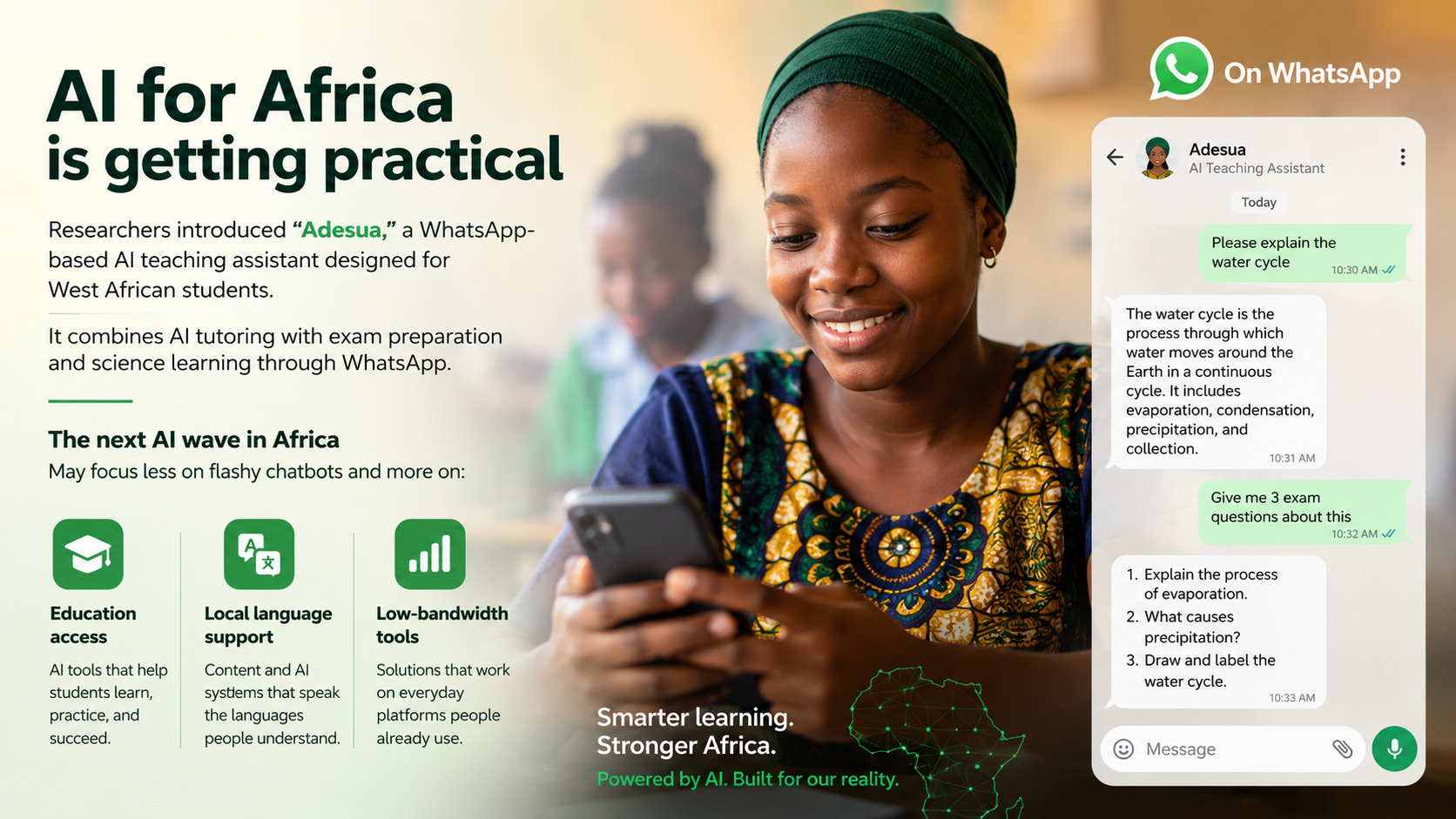
Adesua represents a new approach to educational technology in Africa, combining AI tutoring with curriculum-aligned exam preparation through WhatsApp. The platform specifically targets students preparing for the Basic Education Certificate Examination (BECE) and West African Senior Secondary School Certificate Examination (WASSCE) in science subjects.
Unlike flashy ed-tech ventures that require dedicated apps and robust internet connections, Adesua meets African students exactly where they are. The system integrates curated textbooks and 33 years of national examination questions with generative AI to enable conversational question answering and automated assessment.
Meeting Students Where They Are
The genius of Adesua lies not in technological sophistication, but in pragmatic design. WhatsApp’s widespread adoption in Africa provides accessible, curriculum-aligned learning support for Junior High School and Senior High School students across West Africa. Students don’t need to learn a new interface or worry about app compatibility—they simply message Adesua like they would a friend.
The platform offers two core functions that address real educational gaps. Students can ask science questions and receive instant AI-generated answers based on verified curriculum materials. More importantly, they can take timed or practice tests organized by topic or exam year, then receive immediate grading with detailed explanations for both correct and incorrect answers.
A 6-month feasibility deployment in 2025 had 56 active users in Ghana, including students and parents. While the user numbers might seem modest, they reveal something important: parents are engaging too, recognizing the tool as a legitimate educational resource.
Building on Proven Foundations
Adesua extends an earlier platform called Kwame for Science, which demonstrated the viability of AI-assisted learning in West African contexts. Kwame for Science provides passages from well-curated knowledge sources and related past national exam questions as answers to questions based on the Integrated Science subject of WASSCE.
The original Kwame platform faced significant challenges that inform Adesua’s design. Publishers of approved Ghanaian textbooks were unwilling to partner due to trust issues, making it impossible to use local textbook content. The development team compensated by hiring local experts to provide answers to past exam questions, ensuring cultural and curricular relevance despite the setback.
This obstacle highlights a broader tension in African ed-tech: the gap between technological possibility and institutional cooperation. While AI can theoretically democratize education, copyright restrictions and institutional hesitancy can limit what’s achievable.
The Effectiveness Question
Early results suggest students find the system genuinely helpful. Quantitative evaluation showed a high perceived usefulness, with a helpfulness score of 93.75% for AI-generated answers, albeit with a small number of ratings.
The researchers acknowledge these are preliminary findings based on limited data, but they establish proof of concept. Students are not just accessing Adesua—they’re finding it valuable enough to rate responses, suggesting authentic engagement rather than mere curiosity.
The broader Kwame for Science platform, deployed over eight months, attracted significantly more attention. Deployment had 750 users across 32 countries (15 in Africa) and 1.5K questions asked, with evaluation showing an 87.2% top 3 accuracy. This means when the system provides three possible answers, at least one proves helpful nearly nine times out of ten.
Beyond Simple Q&A
What distinguishes Adesua from a generic chatbot is its grounding in actual educational assessment. The platform doesn’t just answer questions—it replicates the exam experience students will face. By incorporating decades of real WASSCE questions, Adesua helps students understand not just what to know, but how they’ll be tested.
The automated assessment with detailed feedback addresses another critical gap. In Sub-Saharan Africa, the education sector faces significant challenges due to a shortage of qualified teachers and high student-teacher ratios. When one teacher manages 50 or 60 students, individualized feedback becomes nearly impossible. Adesua provides that personalized response at scale.
The WhatsApp Advantage
The choice of WhatsApp as a delivery platform reflects practical wisdom about African digital infrastructure. While smartphone penetration has grown dramatically across the continent, data costs remain high and internet connectivity unreliable outside urban centers.
WhatsApp’s text-based interface requires minimal bandwidth compared to video platforms or app-heavy learning management systems. More crucially, WhatsApp is already the communication tool of choice across West Africa—for families, for businesses, for everyday life. By building on existing behavior rather than demanding new habits, Adesua lowers the barrier to entry.
This approach mirrors successful ed-tech strategies from other emerging markets. Similar platforms in India and South Africa have demonstrated that WhatsApp can effectively deliver educational content to millions, precisely because it meets people in an app they already use daily.
What Comes Next
The Adesua team envisions significant expansions. Future versions may allow students to photograph handwritten questions and receive answers, integrate voice notes for students who prefer audio learning, and add AI tutoring capabilities that guide students through topics step-by-step rather than just answering discrete questions.
Perhaps most importantly, researchers plan larger-scale evaluations with structured student cohorts. The feasibility study proves the concept works; the next phase will determine whether it works at scale and genuinely improves learning outcomes.
A Broader Movement
Adesua isn’t working in isolation. Across Africa, WhatsApp-based educational tools are proliferating. In South Africa, platforms like Maski help teachers generate curriculum-aligned assessments, while Digify Africa’s chatbots teach digital literacy to hundreds of thousands of learners.
What these initiatives share is recognition that technology serves people best when it adapts to their reality rather than demanding they adapt to it. The most sophisticated AI in the world is useless if it requires infrastructure students don’t have or navigation that confuses rather than clarifies.
The preliminary results provide a basis for more extensive future evaluation to assess AI tools’ potential to offer scalable, low-cost personalized learning support in resource-constrained educational contexts.
The promise isn’t that AI will replace teachers—that’s neither possible nor desirable. The promise is that AI can extend teachers’ reach, providing students with immediate support when their teacher is occupied with dozens of other students, or when they’re studying at home without access to help.
For the Ghanaian student messaging Adesua during evening study sessions, the technology is already practical. It’s not futuristic or aspirational—it’s simply there, answering questions through the same app used to message family and friends. That ordinariness might be its greatest achievement.