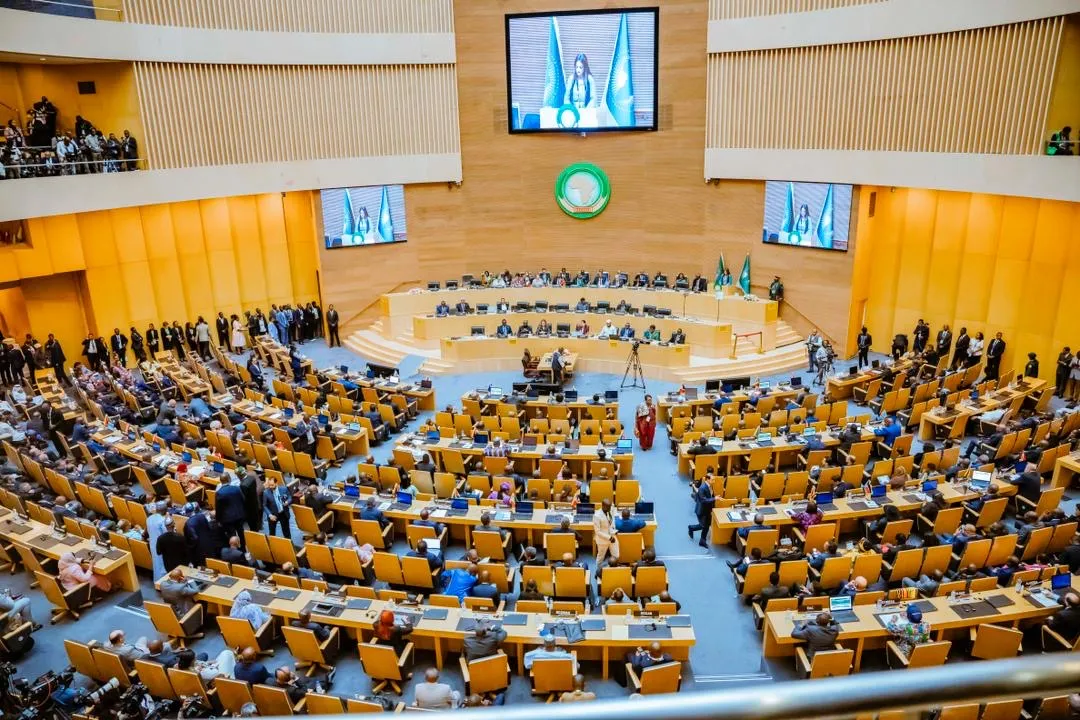
Rabat — In a high-stakes address to the African Union Peace and Security Council on Thursday, Morocco’s Foreign Minister Nasser Bourita made an urgent case for African technological independence, warning that the proliferation of manipulated content is already altering the political landscape across the continent, eroding institutional trust.
The intervention comes at a pivotal moment for Morocco’s digital ambitions. Over the past month, the North African kingdom has unveiled a series of major infrastructure investments and strategic partnerships that position it as a continental leader in the race for AI sovereignty—a bet valued at over $1.28 billion and backed by some of the world’s most powerful technology companies.
The Security Imperative
Morocco is placing artificial intelligence at the center of the African debate, not from a purely technological perspective, but as a tool with direct implications for the continent’s stability, Bourita told the videoconference meeting dedicated to AI’s implications for governance, peace, and security in Africa.
His message was unambiguous: if Africa does not develop its own tools, it will end up managing problems designed from outside. The minister called for the creation of African mechanisms capable of detecting and responding swiftly to disinformation campaigns, emphasizing the need to train specialized personnel within the continent and reduce dependence on foreign technology.
Morocco’s proposals include building local solutions specifically designed for conflict prevention and support for peacekeeping missions. The country also advocates for establishing African monitoring, early warning, and rapid response mechanisms to counter AI-driven threats.
From Vision to Concrete Action
Morocco’s advocacy is backed by substantial infrastructure investments unveiled at GITEX Africa 2026, the continent’s premier technology event held in Marrakech earlier this month.
The centerpiece is the Nexus AI Factory, described as Africa’s first sovereign AI computing platform, announced through a landmark agreement between Morocco’s government and London-based Nexus Core Systems. The headline investment figure is $1.28 billion, with planned capacity of 500 megawatts powered entirely by renewable energy, running on Nvidia’s latest Blackwell GB200 GPUs.
“Yesterday, I witnessed something historic,” U.S. Ambassador to Morocco Duke Buchan III posted following the signing ceremony, reflecting the international attention the deal has attracted.
The Nexus AI Factory combines a high-performance computing facility with a Centre of Excellence focused on skills development and an Innovation Hub intended to accelerate AI startup creation across the region. The project has backing from Nvidia, South Korea’s Naver Cloud, and global investment firm Lloyds Capital.
Phase one, to be built in Nouaceur near Casablanca’s Mohammed V Airport, will activate 16 megawatts of capacity by 2027. Phase two, planned for northern Morocco, adds another 20 megawatts, creating 125 direct positions by 2027.
Morocco is also moving forward with plans for Igouda, Africa’s largest data center in Dakhla, as announced by Minister of Digital Transition Amal El Fallah Seghrouchni at the same event.
A Third Voice for AI
Morocco’s strategy goes beyond infrastructure. The country is positioning itself as what Minister Seghrouchni calls a “third voice” in artificial intelligence—a deliberate alternative to both America’s tech-giant-led model and China’s state-driven approach.
The EU-Morocco Digital Dialogue will connect Morocco’s AI research centers and factories with four European research hubs and advance the Medusa subsea cable project to boost connectivity between North Africa and Southern Europe. The European Union is also considering building an AI factory in Rabat to strengthen the country’s digital infrastructure.
“Morocco can push for ethical, responsible, frugal AI—AI that respects dignity and takes care of populations,” Seghrouchni told Rest of World in a recent interview. “We push for this at the continental level.”
The minister, who holds a Ph.D. in computer science and has published over 200 research papers, has been direct about the stakes: eighty languages across Africa have been ignored by major tech companies. “If nobody else is going to build AI that speaks to them, Morocco will,” she said.
Digital Morocco 2030 and AI Made in Morocco
These infrastructure projects fall under Morocco’s broader “Digital Morocco 2030” strategy and the “AI Made in Morocco” initiative, officially launched with the “Maroc IA 2030” roadmap in January.
The strategy emphasizes digital sovereignty, national skills development, innovation incentives, and territorial inclusion while seeking to reduce structural dependence on external technological systems. Morocco has set ambitious targets: training 100,000 digital talents annually and fostering a robust ecosystem of 3,000 startups.
A key pillar is the JAZARI ROOT network, the founding nucleus of national AI centers of excellence known as the Jazari Institutes. These centers are tasked with supporting technology company growth, encouraging AI adoption by small and medium-sized enterprises, and reinforcing Morocco’s skills development.
Morocco has also launched a joint AI research and development laboratory, Mistral AI & MTNRA, established under a memorandum of understanding with Mistral AI, a global leader in generative AI.
Continental Leadership and Geopolitical Positioning
AI represents a potential $1.3 trillion boost to Africa’s GDP, according to estimates cited at GITEX Africa 2026. Morocco is positioning itself to capture a significant share of that opportunity.
By leveraging its strategic location, diverse partnerships, and active participation in multilateral dialogues, Morocco is well-positioned to serve as an international hub for discussions on ethical artificial intelligence, promoting a balance between innovation, sovereignty, and responsibility, Seghrouchni explained.
The kingdom’s strategic geographic position between Europe and Africa, combined with competitive renewable energy resources and regulatory alignment, is attracting major digital investments. As geopolitical tensions disrupt tech hubs in the Middle East, this move positions Morocco as a stable alternative for data centers and innovation.
Additional partnerships announced at GITEX Africa include collaborations with the European Union on digital dialogue and agreements involving Mohammed VI Polytechnic University (UM6P) to bridge African research with international supercomputing networks.
US Data Centers Morocco and Oréus also signed a memorandum of understanding to establish a joint platform for deploying sovereign AI infrastructure across Morocco, Spain, and West Africa, with plans for AI data centers of 7.5 megawatts per site.
The Continental Dimension
Morocco’s efforts extend beyond national borders. In his Thursday address, Bourita recalled that Morocco initiated the first meeting of the African Union Peace and Security Council dedicated exclusively to AI in March 2025. Since then, there have been concrete advances, including the adoption of a joint African declaration on AI and discussions around establishing a specific fund to finance technological development across the continent.
The country has also been appointed a digital hub for Africa in data science and AI, and Seghrouchni has personally incubated more than 350 women from 28 African countries through her African Women in Tech and AI program.
Morocco is also building a data center intended to serve as a data embassy for the Sahel region, providing capacity for storage, computation, and support for developing new AI models tailored to African needs.
Challenges and Skepticism
Despite Morocco’s ambitious roadmap, questions remain about execution and accessibility. Will the AI infrastructure genuinely serve pan-African users, or will it primarily benefit Morocco and its closest partners? Can the country train skilled personnel at the scale required? Will renewable energy delivery keep pace with the massive power demands of AI computing?
The modest direct job creation figures—125 positions by 2027 for a multi-billion-dollar investment—have raised eyebrows, though proponents argue the broader ecosystem effects will be more significant.
There’s also the challenge of balancing openness with sovereignty. Morocco’s partnerships with European and American technology giants could potentially create new dependencies even as the country seeks to reduce reliance on foreign systems.
Governing in Uncertainty
Seghrouchni has acknowledged these challenges openly. “Nowadays, nothing is completely predictable, so we have to govern in uncertainty,” she told Rest of World. “This means you have to make decisions while keeping the ability to adjust as much as possible.”
Her approach reflects a pragmatic understanding that in the fast-moving world of AI, rigid long-term plans can quickly become obsolete. “Our actions should be in an open world that moves and changes, and we have to make decisions all the time while keeping the ability to backtrack if necessary,” she said.
For Morocco, the stakes extend well beyond technology. As Seghrouchni put it at the GITEX Africa opening ceremony: “Today, Morocco is making a technological bet to serve a new model of sovereignty.”
The bet is that by building AI infrastructure, training local talent, and establishing frameworks for ethical AI development now, Morocco can shape the terms of Africa’s digital future rather than simply accepting them. Whether that vision becomes reality will depend on execution, investment follow-through, and the willingness of other African nations to embrace Morocco’s leadership.
But one thing is clear: Morocco has moved from talking about digital sovereignty to writing checks for it. And in a world where AI capabilities increasingly determine geopolitical influence, that shift from rhetoric to action may prove consequential far beyond the kingdom’s borders.
This reports draws on statements from Morocco’s Foreign Minister Nasser Bourita to the African Union Peace and Security Council on April 16, 2026, as well as announcements made at GITEX Africa 2026 in Marrakech and interviews with Minister of Digital Transition Amal El Fallah Seghrouchni.